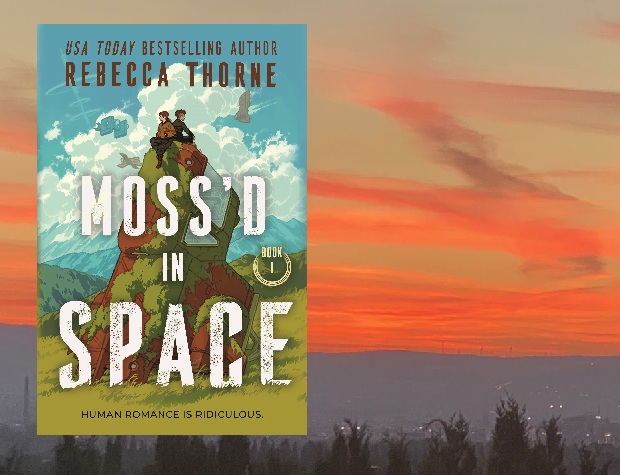
USA Today Bestselling author Rebecca Thorne delights in a brand new cozy science-fiction series…for fans of Martha Wells and Olivia Waite! Features original inside art!
Torian Razner finally bought a starship, and contrary to Amelia’s assessment, it was not “a meteoric sign of stupidity.” Sure, the alien starship may have been abandoned for a century, and it may be covered in moss now… but it’s Torian’s ticket to freedom, regardless of what her ex… ah, captain… said.
Except Torian’s first flight reveals a surprise passenger: the moss is actually an organic computer with a snarky attitude and serious abandonment issues. The target of its loathing? The immortal alien who built it (and then parked the starship, with Moss inside, and forgot about it). The same alien who just found Torian and accused her of “stealing” the ship.
It’s entirely possible that Amelia was right about this meteoric stupidity.
In the book’s end-matter, Thorne explicitly acknowledges the inspiration she got from Martha Wells’ rogue sec-unit.
“Moss came to life in my brain after reading Murderbot, and I feel so lucky to add it to the ranks of sarcastic space entities.”

Of the two protagonists in the story, it is Moss – the sentient semi-organic life support system – who gets the privilege of a first person narration. With that perspective come all the insights into the workings of an – at times – strangely unaware self-aware artificial intelligence. Thorne’s inventive addition to the AI/enhanced human pantheon blends a number of elements. The merging of organic and inorganic is not so much like Murderbot’s squishy and mechanical parts, as Tchaikovsky’s ant based computers (that feature in both Children of Time and Green City Wars) – Moss is literally moss merged with a computer and actively generating the atmosphere that keeps the spaceship habitable. It’s nice to see the debt that fauna owes to flora being built in to a story. Furthermore Moss, while sharing the same kind of acerbic tone of voice as Murderbot’s frenemy ART (Arsehole Research Transport), does not have complete control over the ship that it is part of. Moss runs the life support. Lacking access to the auto-navigation or engine subsystems – Moss found himself/itself/themself stranded in the space equivalent of a lock up garage, effectively abandoned by an owner who forgot (for 100+ years) where he had parked the spaceship. Those abandonment issues do make a nice spine for Moss’s development through the story as character/entity.
The second protagonist is Torian, a once rather inept security officer on an kind of semi-official smuggler ship. Demoted to ‘scrap’ the kind of duty that involves delving in the hidden holds and voids where smugglers stuff their smuggled stuff, Torian has issues with both the women in her life. The first is Amelia, her former captain with whom she shared one kiss and a lot of angst. The second is Celise, Torian’s sister who provides medical support for the poor and needy – but who needs access to clean planet-side air if she is to escape the disease that is killing her in the huge space station that is Colony 13. This creates a nice entanglement of tension as Torian tries to shrug off her attraction to Amelia, prove to everyone that she is capable and can bring a plan to fruition, and also save her sister. That would be enough for anyone without having to wrangle with a fractious semi-organic life support system.
World Building
Space is mostly empty, so it can be a bit of a struggle to pin down the ‘geography’ of the place – never mind the different cultures. I mean one thing that distinguishes a sci-fi novel from fantasy is the absence of a map. So it did take me a while to bend my imagination around the ‘layout’ of Thorne’s setting. The story essentially takes place within a single solar system, but one that has multiple planets – of which only one has been successfully terraformed by humans. The solar system includes – a nebula, which feels more like an asteroid belt – and thirteen or more city-sized colony space stations where people live out their entire lives in huge metal cans of artificial gravity. Although Moss’s vessel is a called a starship, it seems to travel just within this single star-system – although journey times can be shortened through alien technology making use of wormholes.
I enjoyed the sideswipe at immigration policies and practices that Thorne showed in the one terraformed planet of Rhymarra with its much prized and much envied clean air.
“They still expel their own citizens if they don’t pass those ridiculous exams. I can’t imagine they’ll be jumping to bring you, a random spacer, onboard.” Her voice dropped. “Much less me.”
The Rhymarran conviction in their own superiority and their need to limit their population only to those deemed worthy, no matter what desperate circumstances people are struggling to escape definitely rings a few bells closer to home. The very attributes that make the Rhymarran’s feel confident of being the first humans admitted to the Confederation of Spacefaring Species (CSS), actually rank them scarcely higher than the version of Earth that ‘welcomed’ Klaatu in The Day the Earth Stood Still (1951)
Thorne also throws in a trio of differently engaging alien races. There are the formidable Draic, to whom being shot by a bullet is little more than a tickle. There are the Tou’siil – with their appealing hive mind or group consciousness, such that their entire distant community can watch and listen through the senses of an emissary sent to other worlds. And there are the Nylarians – or rather there aren’t the Nylarians since these super-advanced long lived aliens upped and vanished a millennia ago in a rather Marie Celeste like disappearing act. The one solitary Nylarian left behind is Dutch, Moss’s errant previous owner, whose plight reminded me a bit of Christopher Ecclestone’s incarnation of Dr Who as ‘the last of the Timelords’ with the Draic Zen to play his Captain Jack Harkness, and I guess that makes Moss’s starship a kind of analogue for the cranky Tardis!
The whole makes for an interesting cocktail of characters and places as Moss and Torian navigate their different dilemmas.
Plot
The spine of the plot is Torian’s drive to find a safe haven where Celise can live free from the curse of her consumption-adjacent pulmonary disease. Along the way, Thorne throws in a fair few obstacles, some literal (anyone for asteroids?!) some mechanical as a couple of serendipitous engine breakdowns provide new directions and opportunities.
It is in the nature of a cosy sci-fi story that the plot doesn’t have too many unsettling twists, or leave us in doubt or fear for our protagonist for too long. Yes, there are a few near death experiences, but the solutions are usually found fairly quickly. Thus the tension in the story is delivered more in a matter of isolated blips than through a mounting sense of doom and urgency.
Characters
Moss is the standout character from the book in the originality of the concept, the unreasonable confidence in his/its own capacity, the enduring grudge it bears towards its former owner and the scope for unfortunate exchanges from an AI still learning about humans. For example when Moss wants to speak with Amelia (Torian’s ‘non-romantic partner’) but detects that she is in the washroom performing a function Torian described as “showering”.
It was curious to me that Amelia would water herself so late at night. I inserted myself into the microphone and said, “Amelia. Are you sufficiently moist?”
Nasra, the excitable Tou’siil emissary with her own anxieties, is another fun invention.
The fact that thousands of Tou’siil might be watching Torian was intimidating at best, terrifying at worst.
I will also admit a certain fondness for the primitive sub-system Auto-nav, that engages Moss in enthusiastic conversation about “fly, fly, fly.” It reminded me of the sentient Toaster in Hitch Hiker’s Guide to the Galaxy quite incapable of having a conversation that didn’t involve bread products.
Prose
Besides the acerbic observations of Moss, Thorne’s prose nicely captures the awkwardness of maybe non-romantic relationships in the interactions between Torian and Amelia.
Amelia’s blue eyes shone. “I know you hate me. Just let me get you flying again. Then I’ll go my way, and you’ll go yours all right?”
The way she phrased that made Torian feel icky, unsettled. “I don’t hate you. I just … want to stop feeling inadequate around you.”
Or later when one might hope things were moving better.
It was the closest they’d been since the kiss six months ago. And then, because the galaxy was a cruel, unforgiving beast, Celise stomped into the clearing.
In Conclusion
Given some contemporary issues I enjoyed the book’s sideswipes at AI from Moss.
Human AIs were a pathetic excuse for sentience, only useful for data management.
And Dutch’s retort when Torian suggests that the Ryhmarrans are the best of humanity, or at least better than ‘us on the colonies’.
Dutch shook his head, eyes sparkling. “Also incorrect. I’ve been watching humans for millennia. The best of your kind aren’t defined by birthplace or exam scores. They’re individuals. People who make selfless choices, even if they’re hard, to better the lives of others.”
Torian and Moss, as the focus of the story, make an engaging pair of characters who – in the comforting nature of cosy fiction – find solutions to quite a few of their issues through the narrative. The story also leaves a few curious threads hanging – most notably the Nylarians’ disappearance – which may get addressed in subsequent volumes.

Leave a Reply