<Open Rant>
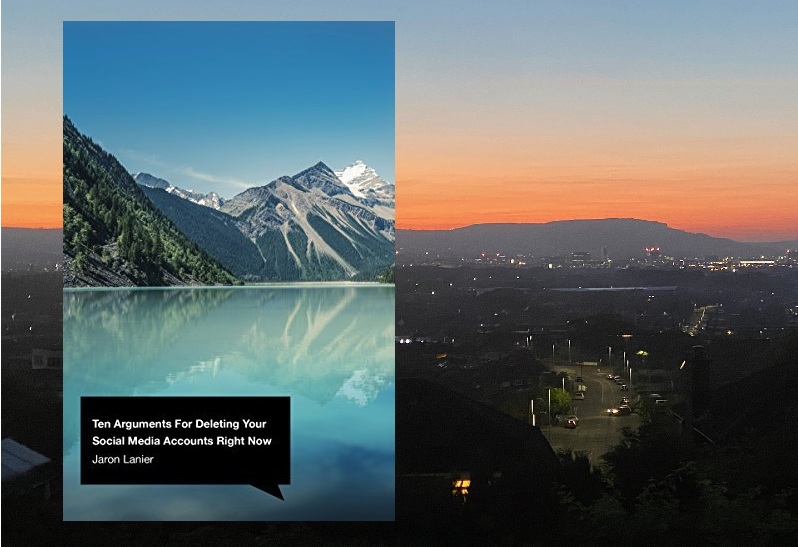
This post is inspired by my reading of Ten Arguments for Deleting Your Social Media Accounts Right Now by Jaron Lanier and it will – in part – be a review of that book.

The book was first published in 2018 in the midst of Trump 1.0 but at a time before Musk took over Twitter. Arguably the issues that Lanier identified have grown exponentially worse in the near decade since then. Keir Starmer’s proposal to ban social media for under 16’s in the UK has attracted a fair bit of attention – including a segment in the satirical programme Mock the Week. While there are undoubtedly problems with young people’s exposure to all kinds of dangers and distractions through social media, the problem is more widespread, dangerous and nuanced than could be addressed by the crude weapon of an age-targeted blanket ban.
Interestingly the EU have conducted their own research into social media perceptions.
Two thirds of Europeans (66%) use social media every day to get information on current affairs or politics. Against this backdrop, Europeans’ indicate as top priorities to tackle false or misleading information tougher sanctions for illegal online content (44%) and stronger rules for platforms (40%), followed by clear labelling of AI-generated or manipulated content (38%), a minimum age threshold for social media access (37%), and greater investment in media literacy and independent fact-checking (29%).
And the EU have just come up with their own proposals which also include an age related ban but within a156 page document indicating how the platform owners, among others, must take responsibility for regulating content.
Principle 4: Social media and other digital services must take primary responsibility for ensuring online spaces are safe for minors to access and use. (My emphasis)
Belatedly governments are waking up to the dangers of an unregulated internet but it remains to be seen if action is sufficient or effective. Lanier’s book was drafted before the Cambridge Analytica scandal had even broken – a scandal that now seems as quaint as Watergate does compared to Trump 2.0 malfeasance. Lanier admits that he was one of the early champions of an open access internet, along with a reluctance to trust government.
The internet in itself doesn’t give you any place to store even a small amount of persistent information, any way to make or receive payments, or any way to find other people that you might have something in common with.
Everyone knew that these functions and many others would be needed. We figured it would be wiser to let the entrepreneurs fill in the blanks than to leave the task to governments. What we didn’t consider was that fundamental digital needs like the ones I just listed would lead to new kinds of massive monopolies because of network effects and lock-in.
The internet presented a business opportunity, much as India was for the Honourable East India Company in the late 1600s and the whole of Africa was for the rest of Europe in the 19th century age of colonialism. It was a place where money could be made and the commodity/resource being traded in was people or – more specifically – people’s attention, behaviours and interactions.
Lanier’ retains an appreciation of the value of the internet, but takes aim at the business model that has grown to dominate the way people interact with the internet – a model he has christened the BUMMER machine (a mnemonic which includes the colonialism element I alluded to).
Behaviour of Users Modified, and Made into an Empire for Rent = BUMMER
Lanier notes the regret of some early executives, including Chamath Palihapitiya – former vice-president of user growth at Facebook.
I feel tremendous guilt… we kind of knew something bad could happen… My solution is I just don’t use these tools [social media] anymore. I haven’t for years.
A friend of my wife’s commented on how the social media executives don’t allow their own children to make use of social media and Lanier echoes this with a note that “Many of the Silicon Valley kids I know attend Waldorf schools, which generally forbid electronics.”
While those at the centre of the social media explosion have the perspective to understand its dangers, the history of technological advances is one of moving too fast for regulation to (at least initially) keep up. The industrial revolution may have induced an explosion in manufacturing capacity, but it came with dangerous and inhumane working conditions which took decades to address through legislation leading up to the Health and Safety at Work Act. One hopes we are at or near the point of peak danger from social media and that governments will get sufficient grip on the beast to make sure it serves people, rather than people serving it. However, the fact that people who profit most from the BUMMER machine also have the ear of those who should be regulating it (in the USA at least) does dampen any optimism.
Lanier considers the addictive-by-design nature of social media is sapping a notion of real ‘free will.’ The accumulation of tiny dopamine hits from ‘likes’ and ‘views’ along with the adrenaline rush of ‘engaging’ in an argument (or agreement!) with someone is what keeps us scrolling and interacting. Like a lab rat pushing a pedal in a cage we are in thrall to “adaptive” social media algorithms. This dark side is hidden behind euphemisms like engagement and advertisers, rather than addiction, behaviour modification and manipulators. As Lanier notes
Engagement is not meant to serve any particular purpose other than its own enhancement, and yet the result is an unnatural global amplification of the “easy” emotions, which happen to be the negative ones.
This is an industry that draws users in and endeavours to trap them in order to profit from them. If you subscribe to a ‘free’ service – you are not the customer, you are the product. Google and Facebook both make their money not from the users, but from the advertisers who pay for access to those users.
In the early days of TV advertising the overall statistics of audience viewing figures and crude demographics were crucial to companies trying to assess if they were getting sufficient bang for the advertising bucks. Like many I was under the impression that Star Trek: The Original Series was a televisual golden cow that got cancelled just before early-stage audience demographics revealed the lucrative seam of fat-walleted young spenders that watched the show. This TV Obscurities article challenges that assumption, but the point about the enhanced value of targeted advertising remains valid.
The issue with social media is how much information about ourselves – effectively our social DNA – we shed through the simple process of engaging with it. Every click, every scroll, every lingering moment allows the platforms to construct a ‘picture’ of hundreds of thousands of data points that define us – not necessarily in a ‘recognisable’ way, but – more importantly than that – in a ‘usable’ way. (Face recognition software and finger print recognition software are not making comparisons with anything so prosaic as a picture of either feature, but are mapping the correlations of particular data points.) This mapping and averaging of social media interactions (aka behaviour) across thousands of ‘statistically similar’ individuals, enables not just the precise targeting of adverts, but also the measurement of impact on subsequent behaviour.

Advertising is fundamentally about behaviour modification. When my mother in law was pregnant with Ash she was advised by her doctor (!) to drink a half pint of Guinness a day as that would help ‘keep her iron levels up’ – in line with the advertising slogan of the day. A few years ago we visited the Guinness Brewery in Dublin and mentioned the story to the guide who said, “Yeah, interesting. We’re not allowed to say that anymore because it’s not true.”
As advertising took off in Madmen era of the 1960s, governments realised the capacity of advertising to make people act, buy or advise against their own (or their patient’s) best interests. Consequently they legislated to protect us from ‘false advertising’ requiring all advertising to be ‘legal, decent, honest, truthful.’
But what social media has provided to business is an environment where commercial (and political) advertisements can be invisibly launched at micro-demographics of targeted groups with the advertisement tuned to their particular basket of concerns and beliefs. For example the last wave of Brexit adverts on Facebook targeting specific groups based on their concerns about health, NHS, immigration, or even animal welfare – with all the adds suggesting the viewers niche interests would be better served by a leave vote.
As Lanier notes
The problem occurs when all the phenomena I’ve just described are driven by a business model in which the incentive is to find customers ready to pay to modify someone else’s behaviour
Lanier is quick to point out that – on an individual level – there can be no certainty that the desired behaviour modification will occur, any more than one dice throw can guarantee a 6. But over a statistically significant number of individuals, the average outcome can be predicted (and paid for) with reasonable accuracy.
Lanier helpfully breaks his BUMMER business machine into six moving parts.
- A is for Attention Acquisition leading to Asshole supremacy
- B is for Butting into everyone’s lives
- C is for Cramming content down people’s throats
- D is for Directing people’s behaviour in the sneakiest way possible
- E is for Earning money from letting the worst assholes secretly screw over everyone else.
- F is for Fake mobs and Faker society.
Fundamentally the flaws that we see and experience in social media are not simply a matter of malicious actors corrupting an internet ‘utopia,’ but down to the flaws inherent in the nature of the ‘utopia’ that incentives the BUMMER business model, so encouraging and rewarding malicious actions.
Social media is biased, not to the Left or Right, but downward. The relative ease of using negative emotions for the purpose of addiction and manipulation makes it relatively easier to achieve undignified results. An unfortunate combination of biology and math favors degradation of the human world. Information warfare units sway elections, hate groups recruit, and nihilists get amazing bang for their buck when they try to bring society down.
Outrage is both a comfortable and a commercially lucrative emotion. To feel outraged is to feel confident you have the higher moral ground, the ethical superiority over those you argue against – and it drives engagement and rewards those seeking attention.
Outrage is also profitable. A bit like the Duke and Duke Commodity traders from Trading Places – who made commission money on every trade whether the price rose or fell – the big beasts of social media make money both from those who agree and those who disagree with them – as was highlighted in an in Independent Newspaper article back in January 2025
Reform MPs including Nigel Farage paid thousands by Elon Musk’s X for posting on site
…
In a recent update, X said it “evaluates earnings based on genuine interactions, such as replies, likes, bookmarks and the time Premium users spend viewing your content”.
However, a former X/Twitter curator, who worked for the organisation for seven years, warned of the dangers of monetising content.
Writing for this publication, Marc Burrows said: “Unlike traditional media, where editorial standards might temper the most inflammatory content, X’s monetisation strategy actively incentivises division.
“The more outraged people are, the more they engage. The more they engage, the more the poster earns. Truth, accuracy and adding value to public discourse are secondary concerns. This is about generating heat rather than light.”
The former curator, who left his post in protest a month before Mr Musk arrived, added: “By monetising outrage, X has created a self-perpetuating ecosystem where inflammatory content rises to the top, dragging political discourse ever further toward the extremes.”
The tsunami of new information pouring through social media every day inevitably demands some ‘curation’, some trimming of this ‘forest’ of reels, memes and soundbites down to a smaller number of ‘trees’ that an individual might manage to engage with.
However, this necessary ‘curation’ has morphed into one of the most insidious aspects of the BUMMER business model of social media companies; the filtering and refinement of individual feeds to lock people into bubbles which – through soothing their biases, or triggering their outrage – most effectively maximises their engagement with the platform.
In a cinema the whole audience will watch the same film and – while they will form different opinions about it – they will not dispute the order in which scenes happened, what actions were seen to be committed or by whom. However, social media gives us all different five minute fractions of the same 90 minute film, leading to utter confusion if we were ever to try and form a shared understanding of what the plot was.
I am often astounded at people I consider rational logical people expressing views that seem utterly nonsensical to me on issues of the environment and politics, but this is the consequence of people living in isolated different social media bubbles and being presented with information in ways specifically designed to trigger apathy, complacency, indifference or outrage.
You are drawn into a corral with other people who can be maximally engaged along with you as a group.
This was of course known back in 2017, when Barak Obama railed against the medias creation of silos awash with misinformation, saying “If I watched Fox News, I wouldn’t vote for me.” But the situation feels like it has only got worse.
Of course, Fox News is main stream media, rather than social media, although – like the foreign owned GBNews in the UK – it does aim to corral its viewers into receiving information from one perspective only. To be fair, the idea of media as a mains of manipulation of public opinion is not new. The Daily Mail in the UK was founded by Alfred Harmsworth with a specific conservative focus and bias. It is perhaps just that the power to corral and manipulate has been turbocharged by social media.
Amongst other points, Lanier draws a distinction between lone wolf and pack wolf types of behaviour and how social media tends to drive us – through its creation of bubbles – into like minded packs or tribes where conforming to the tribe group-think is more ‘rewarding’ than taking an individual self-guided approach. The manipulation of behaviours and opinions is a two pronged attack. Having corralled people into tribes or packs, there is then the sowing so much fear and doubt about the validity of information that people can only fall back on ‘what does my tribe/pack think about this topic’ and then follow the party/tribe line. Benedict Anderson’s Imagined Communities were built around shared language that bound together groups of people who would never even meet each other. Sadly, the communities of the internet are built around shared prejudices, preconceptions and susceptibilities. We should all strive to be more lone wolf – or even cat like – in preserving our individuality of opinions based on proper evidence.
Ultimately, Lanier’s book is a thought provoking and well referenced work which has a way of expressing ideas we subconsciously understood but could not articulate. Alongside his admonition to delete social media accounts, Lanier points out he does not mean ‘delete for ever’ but that there are means to connect, engage and inform that are refreshingly free of social media. There are emails for catching up with friends (though he warns against accounts that are read by the provider – eg Gmail!!). There are newspapers and websites for online news. Youtube videos for instruction and entertainment, and even creating your own website for communication. There many ways to ‘be’ and ‘be connected’ without being part of the social media BUMMER machine, and a bit of distance from its manipulative influence may even give you the space to engage with it in a safer more independent way.
Your goal should not necessarily be to force governments to regulate or even nationalise Facebook before you’ll rejoin, or to force Facebook to change its business model, even though those are achievements that must precede the long term survival if our species. Your immediate goal is to be a cat.

So, I should close this rant by returning to my question
“Who should be banned from using social media?”
My answer is simply the people, politicians, corporations and malign states who would misuse it to run the BUMMER model.
The ultrawealthy already use money to gain an access to power and influence that far outweighs what should be their reach as just one ordinary voter among millions of others.
In the same way they manage their social media footprint to amplify whatever horrible voice (Rupert Lowe, Tommy Ten names) most suits their own self-interested (and slightly insane) agendas.
Since the first enclosures, capitalism has sought to appropriate ‘the commons’ and rent it back to people who never had or needed to pay for it before. The growth of toxic inequality is not simply about the hoarding of wealth, but the hoarding of control and influence.
We need a reset that gives people unfettered, unmanipulated access to the essential needs of a 21st century human life, and that includes connecting and communicating through social media.
</close rant>

Leave a Reply