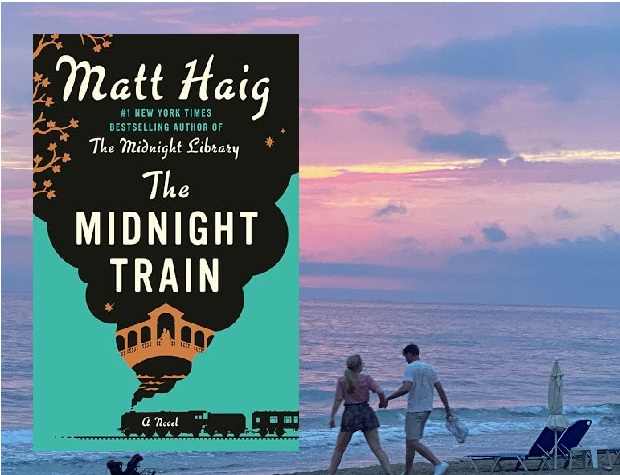
When your life flashes before your eyes, where would you stop?
No one can change the past, but the Midnight Train can take you there. The chance to re-live the moments that meant most. To see what kind of person you really were.
For Wilbur his best days were with Maggie, the love of his life. On his honeymoon in Venice.
Before he gave it all away.
He wishes he could go back and live differently. But to do so risks everything . . .
A magical, time-travelling love story, from the world of The Midnight Library.
I have always loved stories that play with memory, time, reflecting on missed opportunities, exploring the road not taken in all the “Sliding doors” moments of life which I’ve written about for the fantasy-hive here. It is what drew me to Matt Haig’s previous book exploring this theme The Midnight Library, which I reviewed- here. So when I saw The Midnight Train was out it was an absolute no-brainer to get it on my kindle asap.

In structure this is a slightly different book. Nora Seed, the protagonist of The Midnight Library was caught in a liminal space between life and death in the midst of a suicide attempt. That story showed her exploring – and choosing between – all the other parallel lives she might have led had she made a different choice at any one of a multitude of significant prior moments in her life. In The Midnight Train, we meet octogenarian former bookseller Wilbur Budd who has just died and is boarding the midnight train to take a tour through the major events of his life en route into a happy ‘eternity’ with all the people he has lost. Interestingly Nora Seed makes a small guest appearance in this book.
Unlike Nora, Wilbur is not being offered a plethora of alternative lives. Instead he gets a more scenic and sedate version of ‘life flashing before his eyes.’ However, good stories require that their protagonists are changed by the events of the story, which is difficult to do when the character has already lived their entire life. There can be a kind of change in a character coming to an appreciation of the true worth of their life as with Mitch Albom’s story of a life ‘re-examined’ in The Five People you Meet in Heaven and also in the film It’s a Wonderful Life (1946). However Mitch Albom, in revisiting his theme with The Next Five People you Meet in Heaven, recognised the need for characters to have choices and to make changes, an idea he explored further with the opportunity to retake key life moments in Twice.
If Nora’s story was all about an infinite possibility of choices in a Midnight library, Wilbur’s is constrained by the allegory of the invisible train-tracks on which the Midnight Train runs, a train travelling a set course in one direction. The questions Haig poses this time, are how, when, or if Wilbur can change the course of a life that somewhere along the way got shunted in the wrong direction.
With dead Wilbur watching himself in the past there are often two Wilburs on the page, which Haig neatly manages by calling the older, deader Wilbur ‘the ghost’. The Ghost with the benefit of hindsight sees each scene differently to how the living Wilbur viewed it at the time – like a great film or book that rewards rereads and rewatches by revealing hidden nuance and texture. There are the burdens his widowed mother and troubled older brother had to struggle with. There are the missed opportunities to capture his childhood sweetheart’s heart while they were still adolescents. There are the people he misjudged and the priorities he mis-ordered. Another film on a similar theme is the fun comedy drama My Old Ass (2024) about a hedonistic eighteen year old who – through the unwise use of psychadelic mushrooms – finds herself in contact with and receiving life advice from her 39 year old older self. But the nature of the Midnight Train is that Wilbur can watch but not advise or interfere. Or maybe he can, but at what cost?
It is at its heart a love story between Maggie and Wilbur. Maggie is, for much of the book, a more engaging character than Wilbur who – while not actively unpleasant, is often something of a misguided antihero – his own antagonist if you like.
Haig weaves together the threads of their love story with some lovely lines.
Somehow the way Maggie was looking at him made him feel she understood. That was one of her gifts. The way she could read the whole book of someone from a single page.
Wilbur laughed a little at that point. The kind of laugh that lives next to tears.
Being with you let me be a truer version of me.
Away from this central spine the peripheral characters can feel a bit functional. The earnest friend, the single mum, the troubled older brother all reminded me of Willy Russell’s Blood Brothers, albeit without the music track.
As is the nature of these kind of Schrodinger’s Cat exploration of choices and consequences, there are some nice nods towards quantum physics, often delivered through Wilbur’s scientifically minded friend Charlie.
He understood what Charlie had been telling him when he was high on LSD. That life was a kind of spinning coin.
It could be changed by death and also not changed by death at the same time.
And there is also the fragility of memory, never truly recalled so much as reconstructed afresh with each remembrance.
It was interesting to realise that even your own past was new territory to explore. That memories were no more the real event than flags were their nations.
Doesn’t the mundane starch of reality always turn to sugar with memory?
I was just watching an interview with the former snooker player Steve Davis who talked about – as a sportsman – the absolute focus of being in the moment of playing each ball one at a time and putting out of your mind the past and the future – a method which can spill over into a rather unplanned and careless lifestyle. But Haig captures that focus on the moment in a couple of nice lines.
‘The only way to learn is to live,’ echoed Wilbur, almost in a whisper.
So I’m going to try and live them as that… to be nostalgic about the present.
However, one fun feature of the book is Haig’s centering of Wilbur as a book seller, and indeed his guide (conductor) on the Midnight Train is the former owner of the bookshop he frequented as a child and came to own in adulthood. For Wilbur, bookselling is a true vocation.
The joy of joining the right book to the right reader… That was his skill. Like a travel agent of the imagination.
As Haig says in his acknowledgements,
“This is, even more than The Midnight Library, a book about reading. About the importance of reading stories throughout life, of being transported into other lives and places.”
Our world (so the flood of Facebook adverts plaguing my feed might claim) seems to be on the brink of an AI revolution, such that even some capitalists are arguing for a universal basic income – because otherwise how will all the newly made unemployed be able to afford the products the techbros’ AI machines create. Which makes it even more timely to re-examine our addiction to work and our worship of work-ethic. Wilbur may be as much a victim of that culture as those harmed by his preoccupation – for, however many books we read, we each have only one life to lead and we should make it the best we can.

Leave a Reply