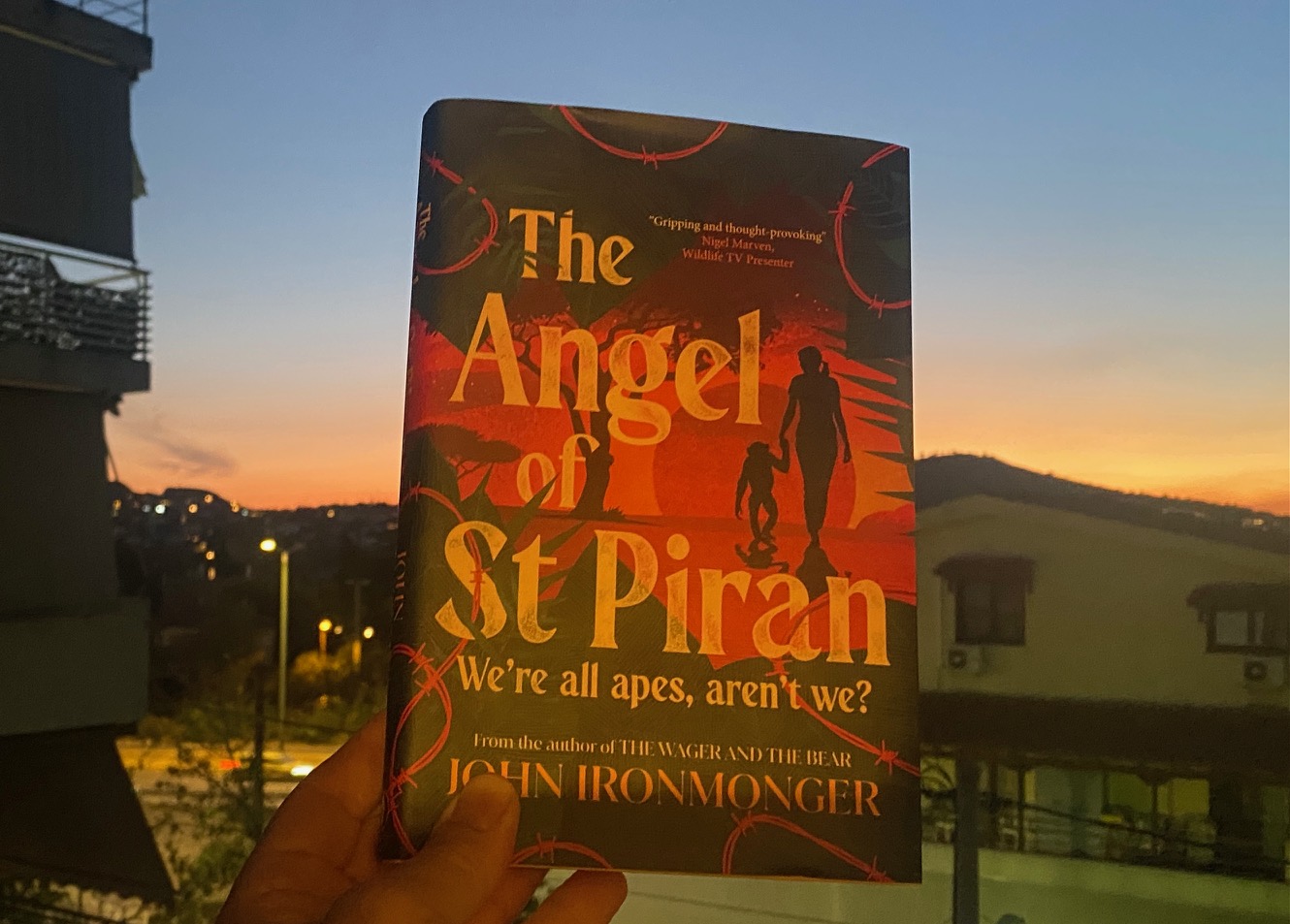
I enjoyed John Ironmonger’s mix of whimsy and climate drama in The Wager and the Bear which I reviewed for the fantast-hive here and I was lucky enough to also get an interview with the author, so his latest book The Angel of St Piran, was a very eagerly awaited pleasure.
I started the book without even reading the blurb and knowing only that it featured a young researcher living within a troop of chimpanzees. Knowing not even the little reveal within the fly sheet certainly heightened my anxious enjoyment of the narrative so I will try to keep this review spoiler free.

Ironmonger draws on a wide variety of experiences, growing up in East Africa, studying zoos and zoology in Chester and a sojourn as a child in the Cornish village of Mevagissey to paint vivid descriptions of diverse places, people and animals.
The fictional Cornish setting of St Piran, some of its most notable inhabitants, and its cosy pub “The Stormy Petrel” have featured heavily in three of Ironmonger’s stories. However, this recurrence is not in the manner of a series, or of sequels, so much as St Piran providing the central hub or common root from which radically different tales can radiate.
This time St Piran is the home of our eponymous heroine, Angel Restorick – skilled (but not Olympian) gymnast and committed primate researcher. It is also the home of her biographer, or at least the custodian of her notes, Jeremy Melon. This gives the book something of the feel of Nevil Shute’s A Town Like Alice with the point of view perspective shifting between the homebased first person narrator’s own experiences of the young protagonist and their third person reconstruction of Angel’s adventures on the other side of the world.
The action pivots on an axis drawn St Piran and Tanzanian island of Samaki in Lake Victoria where a isolated troop of some sixty chimpanzees are the focus of study by a small but dedicated team of researchers, funded by the munificence of a wealthy conservator. Ironmonger (and Melon’s) reconstruction of events opens with a pivotal moment of crisis in the live of the troop Gaffa’s fall, and then goes back to how events led up to this point, before taking us forward to reveal what happens next. Almost as though I had signed an NDA, I really can’t say much more about the essentials of the plot without revealing spoilers and I do think that (like M.R.Carey’s The Girl With All the Gifts) this is a story best enjoyed from a cold start. The plot twisted and surprised me and I was forever finding myself hanging by mental fingertips in anxiety about the fates of all the characters, human and chimpanzee.
One of Ironmonger’s skills is in shifting the register of his prose. In The Wager and The Bear the focus moves in and out between a whimsical omniscience of St Piran events to a close third person account of visceral action above and within an icefloe. In The Angel of St Piran we get a similar capacity to zoom in and out, yet added to that are the almost scholarly asides of Jeremy Melon as he uses his own research and correspondence to fill in ‘events’ and ‘backgrounds’ unknown to Angel’s notes.
Ironmonger’s descriptions of people (and of place) are beautifully characterful, for example this brief snippet about Angel’s research mentor and project supervisor Timothy Cole.
He wasn’t handsome. He had a weathered face like the stone features of a weathered apostle on an old cathedral, rather deep eyes, thinning hair, and that beard.
While the introduction to Dr Noah Waziri is almost a whole page of evocative imagery a full portrait in words. Ironmonger’s sharp eye for character means even the supporting cast are given the dignity of richly fleshed out detail. I particularly enjoyed ‘Coach’ who had nurtured Angel through childhood escape in gymnastics to adolescent competitiveness and a 9.12 at the British championships. The pairing of aloof sister Isadora and condescending and rather creepy brother in law Anton were another well rendered – albeit unappealing – couple, though better targets for the reader’s ire did appear later.
The precarity of our natural world, is a message that underpins the climate crisis in The Wager and the Bear and the conservation efforts of Angel in The Angel of St Piran. A theme on which Jeremy, in one of his first person reflections, speaks eloquently.
There is a fragility to the natural world today that I never knew when I came to St Piran as a young man. The permanence has gone. There is a melancholy now attached to being a naturalist. No one envies us anymore. It is a recognition, perhaps, that we count ourselves among the last generations who will live in a world teeming with wild creatures.
The focus of Angel’s research and the reason why Timothy first approaches her, is to explore the chimpanzee’s capacity for an effective form of language. ,
‘In our conceited, voice-centric view of the world, we struggle to imagine conversation without consonants and vowels, don’t we? Without words.’
The evolution and diversification of language in humans is itself a fascinating subject and it is perhaps no surprise to think that any linguistic skills of other primates would have the same kind of variability as human languages. Hence the value in studying an isolated troop of chimpanzees with a continuous lineage. Angel’s gymnastic training gives her a unique advantage in living within the trees as an occasional member of the chimpanzee troop – albeit the most junior member – as he tries to understand their language. Of course things do not go according to plan and that linguistic research becomes subordinated to an action driven central strand to the plot.
Jeremy’s perspective delivers a very effective framing story to the book and the combination of the opening and closing chapters provide a beautiful, understated, but poignant bookend to the story of Angel and the chimpanzees.
Fly on the Wall Press have as their tag line A Publisher with a Conscience and The Angel of St Piran is certainly a book with a conscience, not just the beating heart of conservation that is Angel Restorick, but in the reflections of other characters and in the informative after-matter where Ironmonger sets out some of the sources of inspiration he drew on for this story. While Angel is neither meant to be Jane Goodall or Dr Catherine Hobaiter, she makes a fine case for further reading of both those researchers work. The characterful line drawings of the chimpanzee characters that Ironmonger’s wife Sue drew are a final joyful pleasure in a fine book.


Leave a Reply