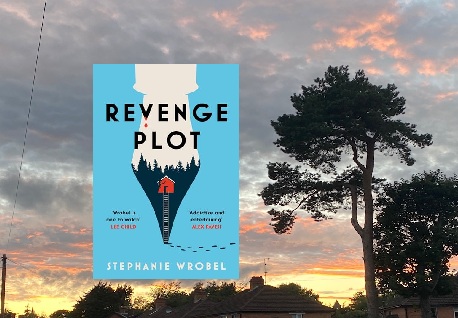
A desperate writer’s pursuit of a powerful literary agent takes a dark turn in this new novel from the internationally bestselling author of The Hitchcock Hotel and Darling Rose Gold.
All Arnie Tenderton wants this Christmas—all he’s ever wanted—is to be a published author. For decades he has toiled over one novel after another. Each was missing something. Until now.
He’s finally written his perfect book.
What he needs next is a literary agent, someone who can get his book into publishers’ hands. Not just any agent will do, of course. Arnie wants the best. Arnie wants Claudia Conley.
She already rejected him once, and Arnie has never forgiven her. He could move on. Instead, he finds out where Claudia is spending the festive season alone in a remote house in the Catskill Mountains. He decides to show up there to make his pitch.
Claudia may try to turn him down again, but this time Arnie won’t take no for an answer.
As a writer and reviewer I do find myself drawn to books that explore the dark mushy interior of the publishing world. In that vein I had already picked up Emily Henry’s Book Lovers, a romance built around the relationship between an editor and an agent. So I was always going to be intrigued by Wrobel’s thriller take on the agent and author relationship.

However, the book is much more complex than a simple thriller. The opening has a kind of Stephen King’s Misery feel to it, albeit with reversed roles, as would-be published author Arnie Tenterden stages a snowy car crash to inveigle his way into top agent Claudia Conley’s remote solo holiday retreat.
The opening 20% of the book is filled with a kind of cinematic tension as Claudia grows ever more suspicious of her accidental house guest and his young son. At times I had to put the book down in the same way one might look away from the screen of a slasher-horror movie. However, as we get into the book-within-the-book of the submission that Arnie so desperately wants Claudia to read, it becomes a different story and I rattled through the remaining 80% in less than a day of compelling page turning (well page tapping – given it’s a kindle).
My initial sense of a simple Misery-style horror of ‘literary professional trapped with psychotic follower’ soon gave way to something more layered and complex. The feelings it evoked echoed the film Deathtrap starring Michael Caine and Christopher Reeve where an experienced playwright entertains a novice writer and potential protege. In the Revenge Plot there is a similar sense of things going on beneath the surface with Claudia being something less than an innocent victim, and Arnie something more than a deluded maniac.
Claudia’s work-related problems revolve around the fading reputation of her star author Jo Stone whose jealously guarded anonymity various internet influencers have tried in vain to crack. Arnie’s problem is a book written in such a mad haste of inspiration that he can’t even assign it to a specific genre.
As Claudia observes
A writer who can’t say what genre his book belongs in has an unfocussed story on his hands.
Yet the self-referential delight of Revenge Plot is that it is exactly like Arnie’s book, in being “a thriller… of sorts”. It tells two very different stories – the tense framing story in the winter woods of the Catskill mountains where Claudia is at Arnie’s mercy, and the travails of an ingenue author story that Arnie finally compels Claudia to read in all its printed, hard-copy glory – and yet Wrobel succeeds in tying both stories together in a very satisfying way. I particularly appreciated the text reference to the Rashomon effect for the whole of Revenge Plot revolves around how different perspectives on events make the observer’s perceptions of who is villain and who is victim tip back and forth like a sea-saw.
Wrobel’s (and Arnie’s) prose entertain and draw in with lush descriptions and shrewd observations.
Between the snow and the serpentine twisting of the road, Arnie struggles to see what’s coming. The forest beckons, extending her arms, and drags them in deeper.
Her agent picks one of those restaurants where the portions are small and the prices extravagant, the chef overly excited about peas.
The text is speckled with literary allusions as online academics deconstruct the work of Claudia’s star author making references to DuMaurier’s Rebecca and the more contemporary Luke Jenning’s Codename Villanelle. Claudia’s existence in publishing is haunted by the threat of ‘scandals’ and ‘cancelling’ which will ring true for any who have heard recent publishing horror stories around allegations of cultural appropriation or use of generative AI. And there are the attempts to rebrand an author for a new market or deploy a deliberate coyness about an author’s gender (dare I mention J.K.Rowling aka Robert Galbraith?!).
As with Henry’s Book Lovers Wrobel offers insights into the publishing industry that will have those in the industry or on the fringes of publication nodding in recognition.
A literary agent is not like an accountant or a plumber, easily recycled with each tax season or busted pipe. The connection between agent and writer is more than business.
…sometimes even she forgot to remember her mother. She wonders if half the point of publishing books is to leave a mark, to say I was here.
“After the pandemic, people quit reading so much once they could leave their homes again. Readers didn’t want dark psychological thrillers… When the world is heavy, readers want light.”
And this one which will definitely resonate not just for would-be thriller writers, but also for those writing more conventional or even Grimdark fantasy as a publisher exhorts an author to persevere.
Please don’t be discouraged … As you know, this is a difficult market for thrillers at the moment. All readers want to read right now is Romantasy.
While those who consume Revenge Plot as an audio book may particularly appreciate Claudia’s robust defence of their chosen route to literature consumption.
“That counts as reading,” Claudia insists, and she means it. She’s never understood the guilt readers carry over audiobooks. What does it matter if you use your eyes or ears.
The problem with reviewing a book with significant thriller or mystery elements is trying to make sure I avoid giving away any spoilers. So there is little more I dare say about the plot beyond the fact that – like all good mysteries – it is fun to go back and re-read the opening chapters to see all the foreshadowing by which the author has treated the reader so fairly with hints and clues that become so Why-didn’t-I-see-that? obvious with hindsight. There were some twists that I anticipated just a few chapters before the actual reveal, but others that were a delicious surprise, putting me in mind of Shakespeare’s Twelfth Night or A Comedy of Errors.
I am always keen to read (and write) between the lines, to find some message in the text that the author’s end matter and acknowledgements may make explicit. Which is not say that every book must have a message – a story’s duty first and foremost is to entertain and Revenge Plot does that extremely well. If there is a message in the text or the acknowledgements it is perhaps one closer to home than I am used to – a message about writing and publishing and an industry that relies on creative talent as much as it can chew up those struggling for their first step on the ladder.
At a convention panel on publishing last year one of the industry professionals made the point that at best 20% of books do well enough to earn out the author’s advance, and the finance directors are for ever asking “Why don’t you just buy those 20% of books then?” missing the point that picking winning novels in publishing is a mixture of skill, dark arts, and lucky gambles.
As Arnie and Claudia argue over the purpose of novels, there is a message that artists in other fields might do well to take head of.
“Readers want happy endings because they know real life doesn’t always deliver them. Fiction is escapism, a chance to order the universe into a just system.”
“Art shouldn’t hold your hand,” he says. “It should be a mirror.”
So Revenge Plot is about the sacrifices and anxieties that go with authorship, and the challenges that go with agenting, and the stand out feature of Wrobel’s acknowledgements is the sheer number of people she owes a debt to for different aspects of this book and her career. Truly it seems like it takes a village to publish an author.
Revenge Plot will be published by Penguin on 29th October


Leave a Reply