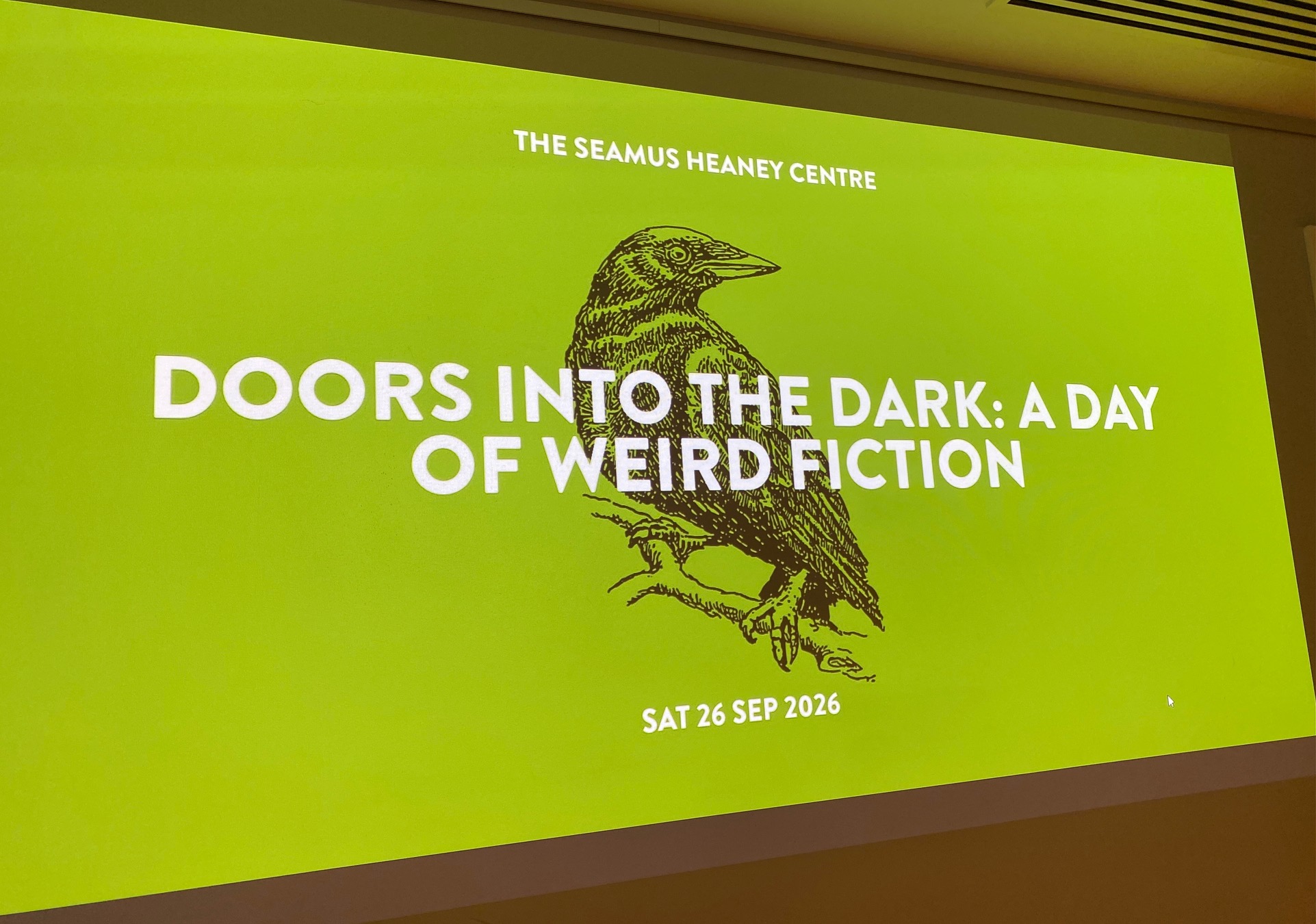
On a sunny September Saturday I headed down for a first visit to the still very fresh new Seamus Heaney Centre on University Street in Belfast for a day of exploring multiple facets of weird fiction.


We were welcomed by Dr Sam Thompson, senior lecturer at Queen’s University Belfast who stressed that the Seamus Heaney Centre, commemorating one of the greatest poets from the island of Ireland, was not simply a part of the university, but a part of the city of Belfast and the wider community of those who love and are inspired by books and reading. The title of the day, suggested by fellow QUB staff member Aislinn Clarke, was very much in the spirit of Heaney and the opening of doors into unknown spaces. Sam also gave a shout out to No Alibis – a local independent bookshop that has been very supportive of a wide variety of local writers and genres – and to all the centre staff who had put so much effort into organising the day.
I took phone notes on the panels I attended and they form the basis of this rather long post, so I have included a contents list to aid your navigation.
Things that go Bump in the North – Reggie Chamberlain King
Sam introduced Reggie Chamberlain King to deliver the opening talk, describing Reggie as a writer, musician and archivist of the unusual – in short a renaissance man of strange things.
Reggie’s talk focussed on Northern Irish writers of the uncanny who disappeared from popular perception, some so completely that he had no precise birth and death dates, or even photographs of them for the presentation (which led to some interesting place holder substitutions with a picture of James Corbett American Heavyweight boxer standing in for James Corbett – the famously bad writer of mid-twentieth century potboiler uncanny fiction).
The German word for uncanny – unheimlich – literally means the ‘un-homed’ and Reggie’s whistlestop tour led us through a list of up to 30 writers who had found themselves in some way unhomed.
There was the bohemian Herbert Moore Pim (1883-1950) who famously “lived 30 lives” and made that a title of one his books. Born a quaker he later converted to Catholicism and changed his name to A Newman (A New Man – geddit?!). Having been active in Sinn Fein to the point of mustering volunteers for the Easter rising, he did a bold volte face and switched to unionism, lived in Grenoble, lost a lot of friends and later married an Italian fascist. In his 1917 story Unknown Immortals about inhabitants of Belfast (characterised as the Northern City of Success) he felt that “Realism would be quite useless as a means of describing them” and wanted to treat them as mythic. Pim wanted to be remembered, but ironically all that reinvention only made him an unknown immortal.
Frederick William O’Connell (1875-1929) was a lecturer in Irish literature who called Belfast the Athens of the North and wrote a story that envisaged Cave Hill erupting like Vesuvius to turn Belfast into a new future Pompeii. He also translated Jekyll and Hyde into Irish where the idea of two identities struggling to be reconciled within a single entity is almost an allegory for Ireland’s political troubles. His short stories included the bizarre The Fatal Move about a chess game where the one who plays the losing move dies – a rather extreme kind of zugzwang! Another story had the notion of an England conquered by Russia with its language and culture outlawed until – in a nice deliberate irony – the last speaker of English John Smith (Ivan Smithovich) escapes to Ireland and tries to pass on his dying language. O’Connell’s awareness of the need to preserve language and the access it gives to culture and history is a nice example of fiction delivering a message as well as a story.
Robert Cromie (1856-1907) was a somewhat prescient science fiction writer who felt that “the universe is a mistake” and wrote a story imagining a pair of world ending atomic bombs (some four decades before the Los Alamos Project!) which a review considered writing of “unmanly pessimism”. He also penned The Lost Liner anticipating a Titanic style disaster around a supposedly “unsinkable” ship a full fourteen years before Belfast’s most famous ship had its date with icy destiny. A near contemporary of Jules Verne and H G Wells, his book A Plunge into Space was dedicated to Verne while he accused HG Wells of plagiarism with First Men in the Moon.
Reggie also talked about Frances Browne (1816-1879) the blind poetess of Ulster – whose Novel The Hidden Sin made use of ghosts and prophetic imagery, Rose Mulholland (1841-1921) – who in her writing about Irish folklore was also writing ghost stories, and Charlotte Riddell (1832-1906) – who was known as the queen of ghost stories with a plaque in Carrickfergus where she was born. Beatrice Grimshaw (1870-1953) was a very widely travelled journalist who ended up in Papua and wrote stories drawing on her local environment on the other side of the world from the Belfast she was born into, including The Forest of Lost Men.
Reggie opined that the reason why the weird and ghost stories survived and remained fresh in any era is because the weird refuses to sit comfortably in its own period and so is equally comfortable anywhere and anywhen.
There isn’t scope here to record all of the 25 writers that Reggie squeezed into a 45 minute presentation (possibly a transcript of his presentation might be made available?!) but I did particularly enjoy the proof of the awfulness of James Corbett’s writing. Author of such great potboilers as Vampire of Skies and The Ghost Plane he was forgotten almost instantly on his death in 1958 but later celebrated as “the best of the worst in” with lines such as these
They knew the anticlimax was at hand.
“Do not speak so loud, one of those men might be a lip reader.”
Uncanny futures: from climate dread to solar punk and beyond
Panel discussion chaired by Caroline Sumpter with Jo Zebedee, Byddi Lee, Rachel (R.B.) Kelly and Matthew (T.O.) Munro.
Being a contributing panellist in this discussion rather restricted my scope for taking notes on my phone, so – while I remember a fun and vibrant discussion – my recall of precise details are a little sketchy.
The panel strove to be hopeful and to draw inspiration from the sense of community support and responsibility that we had seen during covid. Jo was very aware that the future events she anticipated happening in 2040 or 2050 in her book In the Blood Red Sky were actually happening now, with the climate tipping points being reached decades ahead of even Al Gore’s worst prognosis in An Inconvenient Truth.
My own thought was that this is unsurprising given the fact that – despite proven economic benefits and large increases in renewable energy use – global fossil consumption has still increased relentlessly since 2000. That increase is only going to be accelerated by power hungry AI data centres which are far more about creating a market and a need for further fossil fuel consumption, than satisfying any real human necessity.
Rachel said that her debut novel Edge of Heaven was substantially written in the 1990s but published in the 2020s and there is a problem that research for a novel can rapidly go obsolete as we the pace of oncoming disaster accelerates.
Byddi’s climate change satire Toxic Relationships (in which humanity is put on trial) has been staged in each of the years 2024, 2025, and 2026 and each time Byddi has had to do some rewriting to accommodate the latest version of “the worst storm” humanity has ever faced. Byddi noted that, working alongside actors proved a very revealing experience because when you know something, you assume that everybody else must know and understand it to the same extent. But to many of the actors the points she was raising in the play script represented totally new perspectives and information. She had found it gratifying to see how the actors took those messages on board (and hopefully some of the audience too) but it was an interesting illustration of the media and information bubbles we unknowingly live in.
My own concern is that climate change literature tends to be bought by and speak to the already converted. The difficulty in reaching – let alone “converting” a more sceptical audience is real. As Rachel pointed out, sitting in the Seamus Heaney Centre on a pleasant dry day, well fed and comfortable, it is difficult for any of us to appreciate the immediacy and urgency of the climate crisis.
Jo noted that – while solar punk is generally hopeful – it tends to be a post-apocalyptic hope, a favourable future outcome that comes after everything has gone to utter shit (I am paraphrasing Jo here). She felt that writing needs to show people what we can do now.
While I accepted fostering hope is important, I felt that hope is a nuanced concept. It can mean a complacent expectation that someone in power will surely sort things out. John Ironmonger’s novella The Year of the Dugong quotes Greta Thunberg admitting she was a climate change denier (!!) because she figured that if there really was a climate crisis on this scale everyone would be talking about it and acting on it all the time. The assumption that it must be OK because nobody’s doing anything much about it is insidious, particularly when partnered with technological gimmicks and distractions like carbon capture (totally inadequate capacity) and hydrogen fuelled aircraft (far too far in the future to implementation), all of which is about stimulating apathy. Ironmonger’s book has a present time hedge fund manager revived from cryogenic suspension in the distant future and put on trial for terracide and genocide, which appealed to me. Like various social media posts I don’t want history (or the future) to judge the climate criminals of today. I want them judged now, with judges.
The panel all felt a strong affinity for Northern Ireland feeding into their work and their visions of the future, particularly around conflict resolution and the building of community, a perspective that feels all the more relevant given events around the Garvaghy Road.
In a digression, Rachel bemoaned the deeply unsatisfying disaster movies that give no explanation of the apocalypse that has overtaken (usually) the USA and led to lone protagonists struggling to survive a landscape reduced to barbarism. The example Rachel was struggling to recall was How it Ends (2018) starring Theo James and Forest Whitaker, but in the search for that title Leave the World Behind (2023) and The Last House (2026) got (dis)honourable mentions.
Forking paths: game narratives and the art of play
Panel discussion chaired by Sam Thompson, with Thomas Hislop, Darcy Little, and Sam Poots,
In his introduction Sam T. highlighted how games are a narrative experience and – in drawing in new audiences/readership – comprise the biggest industrial form of storytelling that can “trick a lot of people into reading”.
Sam invited the panelists, who were all working in the realm of online and table top game design in a still youngish industry, to share the variety of routes they had followed into the business.
Thomas fell into games through a doing traditional software degree and then a job in Game Studio, he spent 5 or 6 years learning the crazy ways of the medium including branching narrative structures and developing familiarity with the ink open-source narrative scripting language.
Darcy was and remains an avid games player and after a brief obsession with Portal, began leaning into niches through the option modules within their Queen’s degree. Having taken units in Irish mythology they got a job writing Victorian ghosts into games which helped understand the craft of writing and the more specific game skills of prose dialogue, quest text and item description. They noted that “Writing for a job is pretty great.”
Sam P. had been running a tabletop role playing games group out of Coleraine and segued into reviewer and the content writer. When River Horse games wanted guest writers for Jim Henson’s Labyrinth Sam got drawn in when someone else dropped out. That writing credit still goes top of his resume and has opened a few doors. It also helped in learning the craft eg devising adventure hooks.
Sam T. asked about how the panel managed the process of writing games – given that traditional prose is a linear narrative structure where games have forked paths allowing the player to navigate different routes through the story. eg branching narrative structures.
Thomas, with a background encompassing prose and plays, admitted that he now gets anxiety if forced to commit to a single thread. He felt that ‘Games and theatre’ have more in common than ‘games and film’ as the former are both live and therefore potentially glitchy. However, the pacing for games narrative is driven by the player and the choices they make. There is also the use of iconography rather than text to deliver information, with coded images and colours telling you about places and ‘people’. Games writing is a sort of dance with the player setting up expectations and surrendering control to the player. Thomas reckoned you needed 25 mins to an hour of gameplay to properly hook a player before you tried to do anything “whacky”.
He also felt games had a greater risk than prose of “scope creep” where the expanding range of possibilities would generate a kind of logarithmic potential explosion, but a breadth of scape was essential to enable the player to feel that their choices mattered.
Darcy – agreed with this pointing that as a writer you do have an idea of where the story should go, but you must also consider the player agency – as a player you want to feel important in the world/game that you are in! Each character in a story needs to have a sense of what would be their good, mid and bad ending will be! As Darcy noted “It sucks when you play and nothing really matters.”
It was a well made point, although Darcy did say “I’m repeating myself here.” Where Thomas responded with “You’re just entering a game play loop.”
Sam P. felt that the difference between prose writing and game writing depended on the medium. He had found twine to be a very useful free piece of software. It was like the movie Clue (1985), with a central strand of “this is what happened” but then going back to look at different routes to the end (very much a world of flow charts and choices) to provide alternatives “and this is how it could have happened”.
He said, “I hate writing adventures because the players always come up with more interesting ideas.”
But he thinks of setting and the characters the players will meet (a possibility space where anything can happen) but with at least one quest giver to give a strong potential starting point. He also took on board Ian McDonald’s writing advice – read a bunch of plays and see how they use dialogue to shape a scene, very useful advice for writing a game!
Sam T. then threw the discussion open to the audience for questions.
The first one was about AI as the elephant in the room and its potential use in designing the flow of video games?
The panel made a humber of points
They don’t really work too well in macro narratives as Tommy Thompson has written about .
Steam has refunded people who inadvertently played AI authored games – 30% of steam players refuse to play AI authored games, there is a strong moral commitment within the gaming community to eschew AI work.
Darcy noted that that there are so many choices in writing, typically 100 choices in a simple fifteen word sentence, that if you lose the decision making you lose the artistry.
Thomas’s firm had actually lost a contract because a partner on the contract had made undeclared use of AI.
Darcy cited John Searle’s thought experiment about the Chinese room and the fact that AI is a process of pattern recognition and prediction that precludes real understanding and creativity.
The conversation then shifted to discuss more general issues.
Darcy and Thomas both agreed that – while players can very accurately identify what is wrong with a game experience, their suggested fixes are almost inevitably way off – possibly because the point at which they realise something is wrong happens long after the triggering error in the game design.
Darcy still played RPG – mostly online due to location issues – but really enjoyed the sense of writing stories together with their friends and simply hanging out together, which is tricky to do arrange in our contemporary society.
Thomas identified Tabletop RPG as also a useful source of inspiration for online and video games.
Sam P. felt that Table top RPG games have generated a big explosion in the variety of stories you can tell – eg vampire the masquerade – all moving beyond the hack and slash of traditional AD&D. Sam also identified two kinds of creativity in games Apollonian and Dionysian, with the writer as Apollonian bringing the form and structure, while the players as the Dionysian bring the chaos that really gets the creativity flowing.
Thomas considered the issue of including less travelled paths in branching narratives and do they matter if no-one follows them, but felt the existence of alternatives still adds value to the player’s decision to follow a particular (and universally popular) one.
Darcy’s final observation was just that – with Table Top RPG there are just “So many genres to choose from!”
Afternoon reading – the launch of X + Y=K by Ciaran Carson (Lilliput Press)
The timing of the Doors into Darkness event fortunately coincided with the publication of X + Y = K by the late Ciaran Carson, founding director of the Seamus Heaney Centre, so Lilliput press kindly agreed to a lunchtime launch of the book at Doors into Darkness.
The launch began with an introduction by Eamonn Hughes, who thought it very appropriate to be
Celebrating a weird book on a day of weird fiction.
The book opens with an epigram by E.E.Fournier d’Albe that seems particularly relevant to our troubled contemporary times.
“Nobody believes facts merely because they are true”
Having heard tell that “A great book deserves three beginnings” Eamonn opted to give four introductions to the book each taken from Ciaran Carson’s own writing
Within that he noted that Ciaran’s earlier work Exchange Place, makes reference to a book X+Y=K, and wondered if the entire (near 400 page) book was written just to justify the reference in earlier shorter (200 page) tome.
The book is structured in three parts each of thirteen chapters with X being a first person Ciaran-adjacent narrator attending a meeting with his publisher and doing some touristing in 2002 London. Y – narrated in the third person – opens with “A fleet of alien spaceship led by a man in a sarcophagus about to destroy London” while K is (perhaps) a merging of these two perspectives.
Fournier d’Albe was interested in seances and the fringes of science and how it bleeds into fiction, and Eammon noted that the history of spiritualism is often traumatic (one might mention the Goligher family circle of seance hoaxers who deceived Dr William Crawford and possibly shamed him into suicide).
Eammon asserted that Ciaran Carson’s writing invites you to use google to track down references and find that many are grounded in reality and in that liminal space where spiritualism is entangled with science. (Which put me in mind of the heavy 1970s CIA investment into Extra-Sensory Perception, for fear that Russia might be weaponizing “psychotronics” – with Uri Geller being rigorously tested)
However, Eammon’s final observation embraces the strangeness, the sonder and saudade of human existence in all its ordinary miraculous-ness.
“The true weirdness is that we are all here, seems to me what Ciaran is saying”
The introduction led into two readings, the first by Helen Mimosa – a former of student of Ciaran’s and the second by Ciaran’s brother Liam who mentioned Ciaran’s fondness for the works of China Mieville particularly Perdito Street Station and The City and the City for they both embrace that fascination with the urban that Ciaran felt for Belfast.
Following the readings, copies of the books were on sale in the foyer and down the road at No Alibi’s bookstore.
Unhappy at home: contemporary folk horror and ghost stories
Panel discussion chaired by Emma Devlin, with Dominic O’Neill, Tracey Fahey, Deidre Sullivan, and Damien Kelly
Emma’s first question invited the panel to consider the difference between definitions of folk horror and ghost story.
Despite feeling somewhat stitched up as a debutant panellist by being steered into the first response seat, Damien gave a sharp and convincing definition of the difference.
In a ghost story some lost truth will come out eventually but it can can wait for ever, ghosts don’t die. However, in a folk horror we have structured cities, communities and cultures that are destined to die out and the story is about how they are protected and their truths kept buried.
Deirdre agreed with that wonderful answer, but felt that she didn’t think in terms of genre so much as the questions she wanted to answer. Once a work was put out into the world it became a conversation between the work and the reader
Tracey agreed that there are differences but likes it when things are slippery. Ghost stories are unresolved business and the most interesting are the inter-generational haunting where the ghost is an echo of trauma, following a kind of Stone tape theory where buildings record imprints of traumatic events. She felt that the Victorian trope of ghosts coming back to “do something” like Hamlet’s father is too neat and consequently less engaging. For Tracey, by contrast, folk stories tend to be about closed communities that a stranger wonders into (e.g. The Wicker Man (1973). She also recommended the film His House (2020) by Remi Weekes as a good example of folk horror still available on Netflix
Following on from so many deep and thorough answers, Dominic added the thought that to what extent is folk horror simply a ghost story that happens outside?!
Emma then asked in what ways these different genres of stories interrogate our ideas of home.
Deirdre writes in order to “look at things I don’t understand within myself and the world” which is not so rooted in home, but can embrace the Victorian ghosts with an unfinished Things to do list.
Tracey noted that saying these stories disturb a sense of home presupposes that home is a place of comfort. However, the island of Ireland both in its recent (Celtic tiger) history and past (19th century famine) history is full of uncertainty about whether you possessed your own home. So the idea of a home being disturbed by a ghost can be an additional element of precarity, rather than a disturbance of comfort.
Dominic talked about, Haunted Ulster Live (2023), which was set in 1980s Belfast in a house supposedly haunted by a poltergeist, and where the sense of home is about participation and storytelling as the family tell their experiences.
Damien cited Stephen Daly’s The Last Death Poet as an example of an outsider coming to Belfast where home is interrogated as place and notions of family and home are negotiated terms. In the aftermath of the pandemic, we’re trying to look at ghost stories as not being locked in a building (our post pandemic experience of escaping the home now means the stories are also escaping). However, the underlying theme is one where nowhere is safe.
Emma then asked if the appeal of ghost stories was that they reflect anxiety, which gives them a certain currency in our contemporary tumultuous times.
Tracey felt that ghost stories are a comforting place to put our fears into. Horror films/stories are built around catharsis and the release of tension.
Deirdre noted that the world is a deeply terrifying place, “I write for young adults and you sometimes get push back by putting in scary big things into stories.” The popularity of folk horror in a time of climate crisis has at its crux the point that “nobody is coming, you have to sort it out”
For Damien, folk horror is making us awake to the fact that “we” are the threat. Folk horror is about interrogating the structures. Who gets to be here – who are the permitted people – and what are we feeding/starving. He noted that there a certain bleakness or at least ambiguity in the ending of horror. “If people escape at the end of a horror story that’s an adventure.” He also felt that we need some way to deal with our emotional driven stupidity, that characterises those primitive cultures. The 1% of ultra wealthy billionaires is just another old god that we are feeding and folk horror interrogates the question “what the hell is wrong with us?”
The 1% of ultra wealthy billionaires is just another old god that we are feeding and folk horror interrogates the question “what the hell is wrong with us?”
Dominic noted that anyone in their early 20s would have had a pretty shit life with the political and social upheavals (eg the rolling back of rights and opportunities we had thought had become axiomatic?). The current crop of horror consumed in cinemas often hark back to the 1990s and a sense of home that the twenty-somethings maybe didn’t have.
Emma then asked the panel where their practice originated.
Damien remembered being freaked out by Jaws (1975) seen at far too young an age and leaving him with a life-long fear of sharks. However various family driven experiments with psychology and a kind of cognitive behaviour therapy (involving a vast glass shark filled aquarium in South Africa) refined his notion of fear. The context for fear is the limitations of where you are, eg in Jaws it is about fear of water, of the place where bad things happen. Dread is the distance between what you are writing and the reader’s fear of that happening to them. So Damien’s writing is about isolating the character.
Deirdre’s writing experience was formed by The Little Mermaid. Ariel made all the sacrifices she had to make to assimilate into a society she didn’t understand and still was punished – which really spoke to Deirdre as an autistic little girl. So her method is to look for the things that scare her and do obsessive research, “to follow my interest and run my hands over the things that scare me.”
“to follow my interest and run my hands over the things that scare me.”
Tracey’s formative child experiences came from a grandmother who was a folklorist who shared stories with little sense of age appropriateness, and grandfather who was a cemetery keeper. This made for a very anxious child, and an interest in the medical gothic and the fears in inhabiting the female body. She felt that 60s and70s folk horror is quite colonial so was fascinated by folk horror that comes from “inside the tent” from somewhere unexpected within the community rather than the stranger arriving.
Tracey also mentioned being inspired by Misty – a spooky British horror comic for girls, a contemporary of comics like Bunty and Jackie, but exploring much darker themes. It is now available in reprint.
Dominic cited Darby O’Gill and the Little People (1959) as one source of inspiration, which he had rewatched recently. He was also impressed by the original Halloween (1978) which he saw aged 12. He noted that working in film puts constraints on creativity limits and low budget can be a pain in the ass. However, it also brings huge much autonomy and allows film makers to be as high concept as they want. He is always aware of the limitations when writing so wouldn’t write a space battle. However, you work with what you’ve got and that can be empowering, for example with the Ulster Scots films produced for the BBC he knew each film could only have three actors and one location.
Emma then asked, thinking about the climate crisis how do the panel respond to the current moment in their writing.
Landscape has always fascinated Tracey. In her short story collection Queens of the Crone Age, – the mythical hag is the landscape as well as being a custodian of the landscape. Ireland as a ‘thin’ country with stuff beneath the surface. The hag stands for the wounded healer who must be healed – the landscape that must be healed, the story is more “folk punk” than “solar punk.” An assertion that going back to the old ways is not all bad which is the antithesis of folk horror.
Deirdre feels a sense of responsibility to have (non-saccharine) hope for her predominantly YA readership but she writes for herself because if she thought of anyone else she might just stop! “I like liminal spaces. I don’t really like endings. Writing for YA I am writing about acquisition of knowledge, but I try to avoid the sense of weariness that might grey the pink clouds.”
For Damien, with a book called Holiday coming out at the end of the year, great folk horror often exists “within the tent” and his protagonist is within the tent and very comfortable within it. He recalls a conversation at 2019 Dublin Worldcon where an American fan full of the joys of exotic elvish fae asked Peadar O’Guilin how best to describe the fae; given that Peadar’s book The Call is about dark fae who abduct children and return them hideously mutilated it is perhaps unsurprising that the fae are best thought of as “Alien”. Damien also feels that there isn’t an origin story for Ireland as it is land that has been successively stolen – and as such stands as a metaphor for the planet.
Dominic is inspired by the old 80s and 90s tech – observing that “baby monitors with low frame rate are so creepy!”
Finding families: YA urban fantasy and building a community
Panel discussion chaired by Jo Zebedee, with Stephen Daly and Siobhan Murphy
Jo asked about the themes in the YA market that the panellists picked up in their work
As a member of the LGBTQ+ community, Stephen said that was a definite theme in his own writing and one that he wanted to see more of, but made the point that it’s not a genre, it’s a theme alongside issues of identity, belonging and that liminal period between childhood and adulthood. This goes along with ideas of power, inclusion and rebellion – but against what.
When Stephen mentioned that the YA audience is the 13+ age rage Jo noted that in her bookseller experience a lot of adults also buy YA.
Siobhan said that the themes in her own YA were about finding your place and finding your people, people who love you as you are.
Stephen particularly felt we needed Northern Ireland set teenage stories as people in power within the country are ‘not kind to teenagers’ – citing as an example that conversion therapy has not been outlawed here.
Jo described her own writing as crossover fiction, which publishers don’t like as they can’t work out how to sell it. It is not so much ‘coming of age’ as ‘coming into adulthood.’
Jo noted that YA is still a relatively new genre that has interrogated ideas of coming of age, love triangles and found families, and she asked how far the panel were driven by these popular themes or their own themes.
Siobhan felt that YA should be hopeful about a difficult world, but noted that some element of romance has also been expected, though the genre may be moving past that now.
Stephen’s The Last Death Poet was turned down by big 5 publishers as they couldn’t work out how to market it and he agreed there is still a pressure for romance. He felt that hope is something that should be generated in the reader rather than being on the page and also stressed the importance of respecting the minds and hearts of the readers – “Don’t speak down to them, YA are very tired of being spoken down to!”
His advice to would be YA writers is to read YA to reconnect with your inner teenager/rebel, and in your writing address that sense of “I don’t fit in my home/family anymore.”
Jo said that stats suggest YA reading has dropped off, possibly because the big publishers – being rather monolithic in their processes – have not caught up with YA trends. Tic-toc trends are about ‘spicy-ness’ and this kind of flux in the market is something the big 5 are slow to respond to.
Stephen observed that bookshops are welcoming towards parents and young children but less so YA unless they are big stores (eg Waterstones) where YA customers can merge and blend in a crowd. Having a cafe is also good as YA come in for food. Another problem is secondary school curriculum which is dull, and not fun and tends to tell readers what they should think about books and what is good/bad rather than letting them enjoy reading.
Picking up on Jo’s point about rigidity of the big 5 publishers, Siobhan noted that small publishers do have more flexibility but lack the reach of the big 5.
Jo’s sketched out some of the successes she had enjoyed opening a bookshop in Carrick, and felt bookshops need to welcome YA and let them hang out and sit down and maybe have coffee?!
Stephen gave a shout out to Children’s Books Ireland as an organisation supporting authors, parents and teachers in promoting children’s reading.
Siobhan stressed the importance of writing communities enabling people to make connections, to share, read, recommend and help people find each other and talk about what is happening in the community. For example discussing the controversy over Kelly McCaughrain’s book Little Bang being censored because it portrayed teen pregnancies.
Stephen noted how so many YA books clearly haven’t been read by some of the would be censors in political or administrative power as they are a huge raft of potentially ‘controversial’ themes being explored in the genre. Stephen expressed his desire for more people to write YA and to respect that readership and how they get hungry for books. He was also very aware of the supportive and selfless community of writers and how they want people to read, not necessarily their book, just any author’s book.
Jo then opened the floor for questions the first of which was “What is difference between a YA book, and an adult book with a YA protagonist?”
Siobhan felt linguistic perspective and reading age were important so a feature of YA would be more accessible language. Theme and appropriateness were another consideration particularly around violence and gratuitousness. For example To Kill a Mockingbird has a YA protagonist but its themes ensure it is marketed as an adult book. However, publishers have a need to categorise and can’t cope with greyness.
Stephen pointed out that children “read up” so a book with a 16 year old protagonist is read by a 13/14 year old reader, which also has an impact on narrative choices about themes.
Jo mentioned the existence of an emerging genre of “New Adult” bridging the YA into adult books, with a target audience age of perhaps 18-30.
The next audience question was about how – or if – an author who was not themselves from the LGBTQ+ community could write a character from that commnity.
Stephen’s advice was it was important for such characters to be represented in books – without their identity necessarily being a plot point. He suggested one might be wary of writing an LGBTQ+ character as protagonist if one had not lived that experience. For example he himself would not write a trans main character since he isn’t trans. Two other issues he noted were don’t be “mining a trauma” from a character’s life experience and also be wary of writing a story that might close off an avenue to publication for an author from that background. That is to say, “am I the best person to tell this story, or am I going to block an author who actually has that lived experience to use in their own writing.”
Other events in the day
Being only one person and one with cat sitting commitments, I could not get to all the panels or stay until the very end of the day. However, the packed programme for the day also included
- A lunchtime workshop on sharing new SF writing, with author and publisher Mark Mullan.
- a panel on Strange business: publishing weird fiction, Chaired by Hanna Nielson from Yellow House Press and Belfast Review, with Trevor Kennedy from (Phantasmagoria) and Brian Showers (Swan River and Green Book)
- A session at the Queen’s film Theatre on In a Glass Darkly: Irish Horror on the page and screen Introduced by Lucy Baxter with Mervyn Marshall and John Patrick Higgins
- and the day concluded with The Undertow: showcase of new fiction hosted by Emma Devlin and Niall McKenna
All in all it made for a fascinating and illuminating day of discussions and information that will certainly feed into my thoughts as I consider ghosts and witches in my latest ARC (Falling through Time by Claire North).
Many congratulations to Sam Thompson, and the team particularly the near ubiquitous Rachel Brown – who ensured it all went off as smoothly as it was entertaining. Hopefully this kind of event can become a regular occurrence at the Seamus Heaney Centre.


Leave a Reply