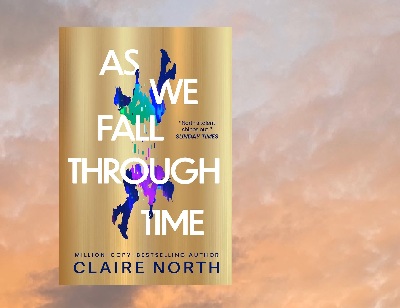
From the multi-award-winning Claire North comes an extraordinary and epic tale of time travel, betrayal and a love that echoes through the centuries.
In the beginning, the world will end. This is the story of what happens next.
When Cal meets a soldier of the French Revolution, he knows his lover is destined to die. But what is the point of being a time traveller if you can’t make a few small tweaks to the course of history? A little paradox here, an alteration there – nothing Cal can’t fix, to save the man he loves.
When Fadimatu walks into a museum in 2018, she stumbles upon her own mummified corpse, setting her on the path to a betrayal that has already killed her, and a murder that has not yet come to pass.
And when a sudden rupture in the fabric of history rips through the lives these travellers have built, breaking both past and future, they must reckon with death foretold, love forsaken, and a secret that will shatter time itself.
Fall through history on a thrilling journey of shattered time, broken futures and a love that can never be erased.
I love time travel stories and I love Claire North’s writing which ensured this book was even more of a delight for me than Slow Gods (and I loved Slow Gods). North has brought out the best aspects of all my favourite time travel stories and woven them into a compelling twisted narrative, criss-crossing paths through time and space.

I will start by listing all the stories that this brilliant novel evoked for me.
- The Star Trek Original Episode All our yesterdays set on the dying planet of Sarpeidon where the population have all escaped into their planet’s past.
- The Dr Who story Day of the Daleks where the Blinovitch limitation effect is first introduced about why time travellers can’t have multiple goes at resolving the same problem at the same time.
- The film TimeCop (1994) where something like the Blinovitch limitation effect is put into use when a timetraveller meets himself somewhat catastrophically.
- The book and TV show Outlander where ancient rocks are a route into the past.
- The film Highlander (1986) (not the sequels or the remake because as the original film put it ‘there can be only one’) with its protagonist accidentally discovering his own specialness as one of a very select band and then having to come to terms with the opportunities and challenges created by that ‘specialness.’
- The book and maybe the film The Time Traveller’s Wife (2009) about the criss-crossing of time lines as two lovers navigate a decidedly non-linear relationship.
- The film and the book Jurassic Park (1993) about what you might dig up from your planet’s distant past, and what you might do – perhaps riskily – with it.
- N.K.Jemsin’s The Fifth Season with its enigma of the narrator who is addressing the reader in the second person.
- Christopher Nolan’s gloriously chaotic time travel film Tenet (2020) with its pell-mell action and combat scenes, which play with questions not so much of where and what, as who and when and how!
- Tony Scott’s time travel movie Deja Vu (2006) with its questions of causality and consequence and how far one can change what was always going to happen.
- The Terminator (1984) and Terminator 2: Judgment Day (1991) about what the future might do to protect itself, or to change itself.
- The grand-daddy of Time Travel stories H.G.Wells The Time Machine with its flashing images of fast passing time and a bleak vision of a possible far future, where evolution has carried humanity far from its ideals.
- The First Fifteen Lives of Harry August which is the first North book that I picked up and which drew me in with its brilliant imagining of a specially gifted kind of person and how his life/lives might play out alongside the hedonistic, the misguided and the power crazed of his peers.
As We Fall Through Time rolls all those elements and aspects up in a gloriously captivating narrative.
Worldbuilding
One might expect that a story set in our world, and indeed largely set in our past, might demand less worldbuilding than a fantasy epic or a space opera, since so much is already given. However, North imagines her time travelling protagonist Cal projecting centuries forward into the differently built future, which involves depicting how the impacts of climate change and the flawed efforts to reverse it have played out. Our civilisation’s future is like a car towing a fishtailing caravan where every effort at correction only exacerbates the problem accelerating events towards the inevitable catastrophic crash.
North also has to address the mechanism of time travel and I loved the significance of old walls and old buildings. There is a seductive stone tape theory that buildings somehow keep a record of events that happened in them (and I often wonder when I visit old ships what stories their centuries old timbers and iron plates could tell). For North, however, those old structures – wherever they may be found – are the doorways through which a time traveller can fall into any past or future where that wall has stood.
North also has to address the fundamental problem in any time-travel story, the potential for a grandfather paradox. If Cal changes anything, then history could surely unfold in a very different way, or split into different timelines – as in Back to The Future II . North eschews the multiple worlds implicit in The First Fifteen Lives of Harry August and instead imagines a paradox as being an instability in time itself – a wound – created by an unwise intervention of a time traveller. That damage can potentially be healed if ‘fed’ a suitable artefact. The artefacts in question called aramanthines are everyday objects that have in some way confounded time and been caught – like Schrodinger’s cat – in a superposition of states, objects that are at once broken/whole or existing/not existing.
Given Cal and his time-travelling colleagues have a tendency to meddle in small ways with the course of history, aramanthines are highly prized to seal up the wound-like paradoxes they create. For while the paradoxes are ‘open’ they can allow ‘ghosts’ to escape into our world and drive people mad, and if left ‘unhealed’ the paradox can become unstable and explode through both time and space wiping out places as big as a city block and erasing any people and their history for decades or even centuries either side of the moment of paradox. The extent of the devastation (within all dimensions of the space time continuum) depends on the ‘size’ of the paradox.
As with the Blinovitch limitation effect, one of the easiest and most dangerous ways to create a paradox is for a time-traveller to meet themselves and inhabit the same space, as Aaron McComb discovered in Timecop! Which introduces a need for caution in Cal’s time jumping. And if that weren’t enough, North populates her temporally fluid world with witches and ghosts – each posing lethal threats to our protagonist.
Characters
Our protagonist is Cal essentially a human aramanthine – as all time travellers are. A very rare person whose ambiguities of birth, of inhabiting a moment of being and not being, gives him the capacity to fall through time travelling forwards, or backwards from his original life as a lowly serf in feudal England. We first meet him in revolutionary France chatting to a young officer Olivier and, for various reasons, their relationship grows and Cal sacrifices a few aramathines to rewrite history and keep Olivier from a premature death so the two of them can maintain an idyllic life. However, Cal is already an experienced time traveller by then. North’s temporally fluid tale allows us to glimpse different tacks in the course he has sailed back and forth through the tide of times up to that key first meeting with Olivier, as well as the carrying them both into a dangerous future. I particularly liked Cal’s gender fluidity which came from the same fundamental ambiguity that made him/her a time traveller.
Thank you? Cal replied, and in the afternoon she slunk off to 2022, and checked herself into a motel room, and had a nice long sleep and woke up male, and went to buy himself a baseball hat and a pair of sunglasses before remembering he didn’t have any era-appropriate money.
As with Slow Gods North prioritises personhood and relationships over the labels of gender.
I liked the soldierly Olivier, committed to ideas of duty, desperate to believe in something with a passionate loyalty – be it a king, a general or an emperor – though his true loyalty was really closer to home, to the men under his command and to Cal.
I loved Cal’s fellow time travellers. There was the bookish Fadimatu ferociously preserving the knowledge of humanity in a far future library in Oslo, while also travelling back in time to experience the past that she was recording. And there was Cal’s mentor Bede, whose first appearance is something like Sean Connery’s Juan Sánchez-Villalobos Ramírez to Christopher Lambert’s Connor MacLeod in Highlander although, Bede strays somewhat from that trope and is the source of some of the most chaotic Tenet style action.
But my favourite character – apart from Cal himself – was the narrator, whose physical presence in the story first reveals itself with the jolting line
I look for an alternative means of travel.
In The Fifth Season N.K.Jemsin kept the identity of the narrator who addresses the reader as ‘you’ secret to the very end of the trilogy and for good reasons. One does not have to wait quite so long to find who is telling us the story in As We Fall Through Time and there are some delicious clues sown along the way. We gather more and more insights into the thoughts of our somewhat unreliable narrator (a judgement they would most fervently dispute) and each reveal is a lovely ‘wow’ moment.
Prose
North’s prose sings and spins through time in the most delightful way. There are sumptuous descriptions for example when we first meet Olivier
Beneath his powdered wig, Olivier’s closely copped hair was a fluff of ash brown. His eyes, owl-like in a face of low hills and soft valleys, were two green-grey baubles caught in an expression of perpetual wonder that his lived experience did not merit.
The times of the ancien regime in all its inequality resonate with our own times.
the stone villas of rich and oblivious men
This is an age of strong opinions loudly held – doubt is an unwelcome guest
Like Cal’s own journeys through time, North’s prose sometimes sweeps the reader along in a torrent like pace of quicksilver images – as though seen from the seat of H.G.Wells time machine – and at other times settles into a deep comfortable enjoyment of people and place. There are points where even the text’s structure has a poetic feel with moments of enjambment heightening the sense of hopping between times in a way that warps time’s arrow into a pretzel shape.
Plot
One can’t say too much about the plot except that I’m sure North must have had some kind of spreadsheet structure (or a board with lots of coloured string) to track the movements and interactions of her time travelling characters. Where Audrey Niffenberger in The Time Traveller’s Wife only had time hopping Henry to slot in and around temporally challenged Claire North has Bede, Cal, Fadimatu and others dotting around more than one conventional human relationship which makes the relationship between the plots of the two books something like that between Einstein’s special and general theories of relativity.
Slow Gods, with its long foretold interplanetary disaster, was an allegory for climate change. As We Fall Through Time is much more upfront in envisaging and inspecting a disastrous climate changed future. In The First Fifteen Lives of Harry August North had Harry made aware of a future disaster possibly created by one of his peers that was reaching into the past in ways that would bring about an end of times. For our own time, the future disaster shadowing our days is not so much The Terminator‘s AI robot riven world, so much as the grim truth of climate change. If you were a time traveller, would you not try to change the past to improve the future in some important ways? The questions North poses for those who contemplate such an approach are firstly – like the trolley problem – Who and how many do you sacrifice for the greater good? and secondly how far does the problem lie with individuals (the great man theory of history) and how far with the systems that created those individuals and others just like them?
This impending disaster and its potential outrun are the foundation on which North builds a very human story of lost loves, loyalties, friendships and conflict – it is a story that manages to be delightfully deeply human even when it isn’t.


Leave a Reply