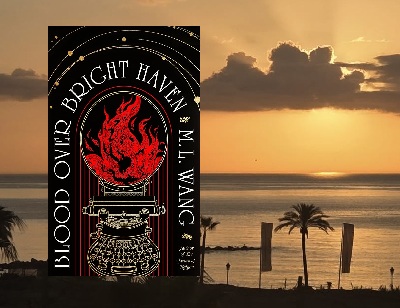
Discover the gripping dark academia fantasy about the limits of truth and power from the author of The Sword of Kaigen, perfect for fans of Babel by R. F. Kuang, Leigh Bardugo’s Ninth House, and V. E. Schwab.
For twenty years, Sciona has devoted every waking moment to the study of magic.
When she finally achieves her ambition to become the first woman admitted to the High Magistry at the University of Magics and Industry, she finds herself undermined at every turn. Instead of a lab assistant, she’s paired with a janitor, putting her crucial research at risk.
But Thomil wasn’t always a janitor. Once a nomadic hunter from the wild plains outside the city, he now sees a chance to understand the forces that decimated his tribe and drove him from his homeland.
Together they will uncover an ancient secret that could change the course of magic forever – if it doesn’t get them killed first.
I bought a kindle copy of Blood Over Bright Haven after a recommendation from a friend who had picked it up by chance after popping into a local bookshop and seeing it as one of the staff’s recommended books, which just goes to show that bookseller recommendations and friend/word-of-mouth recommendations do sell books!

I first encountered M.L.Wang’s writing in the fifth Self-Published-Fantasy-Blog-Off (2018-2019) when her entry The Sword of Kaigen won the competition with an average score of 8.65 out of 10 – equaling the top score that any SPFBO book has achieved before or since. The Sword of Kaigen went on to win the Champion of Champions competition in December 2025 making it the adjudged best of nearly 3000 self-published books examined in the first ten years of SPFBO. The success of the book had led Wang into a traditional publishing deal with Del Rey to re-release Blood Over Bright Haven.
I had been warned that the start of Blood Over Bright Haven was a bit exposition-y and, after a dramatic and traumatic opening dash across the ice, we do settle into a lot of detail about the magic system and the academia and politics of the Bright Haven that is the city of Tiran. However, that detail is important in understanding some of the twists and turns in the plot, particularly the dramatic reveal that upends everything at around the 40% mark.
One of the features of The Sword of Kaigen was how Wang defied some authorial conventions in the way she structured her narratives, even down to the placing of the climax which – in Sword of Kaigen – came in the middle rather than near the end. However, while editors and traditionalists might tear their hair out at such rule breaking, Wang’s instincts are sure and her decisions work. Glancing back through the opening pages of Blood Over Bright Haven, there is much to re-read to appreciate the seeds that Wang has sown that will flower later in the book.
The first section of the story puts the ambitious, focused and self-centred Sciona Freynan centre stage as she strives to make her way in the intensely patriarchal and misogynistic world of academic mage-craft. Tiran is a city sustained by magic, by the ability of its mages to draw energy from the ‘other realm’ to drive its many machines of industry and transport. The mages also maintain the magical barrier that keeps Tiran safe from the blight which plagues the surrounding land, a curse that strikes at random, as unseen forces flay skin from flesh and flesh from bones, turning living breathing bodies into bloody flowers on snow.
The immediate challenge facing Sciona and her Highmage peers is to find a way to extend the barrier beyond the parameters that the city’s founding fathers set 300 years earlier, so that Tiran can grow with its expanding population. As the newbie and the only woman ever admitted to the ranks of the 100 high mages of Tiran, Sciona faces pressures familiar to any woman who tried to make progress in academia in the late nineteenth or early twentieth centuries, a gender prejudice that even Charles Darwin tried to defend in The Descent of Man – being roundly critiqued by the formidable Antoinette Brown Blackwell. And that makes for an interesting source of conflict, and gives some sympathy for the otherwise arrogant and unlikeable Sciona who is compelled to be twice as good as the men to earn only half as much credit. Sciona’s frustration and scornful determination bleed through in her rebuke of her rival Highmage Renthorn, and in the rant she launches in safer company.
Renthorn’s smile soured slightly. “You know arrogance never made a woman more attractive.”
“When I care how attractive you find me, I’ll let you know.”
“Husbands have been putting their names on their wives’ work in this city for three hundred years. And if it’s not a woman’s husband, it’s her boss…”
As we understand some of the forces of discrimination and parental abandonment that have shaped Sciona, Wang gives us glimpses of her capacity for empathy and regret.
Not the cobbler’s daughter, then. This child had no father. The hard steel engine at Sciona’s core softened slightly.
This would be her vengeance–for herself and for the mother she remembered only as a weak and loving smile.
That casual misogyny of peers leads them to force Thomil, a kwen janitor on her as her research assistant. The Kwen are people from the land beyond the barrier, like the Celts of our own past they comprise different tribes of hunter-gatherers who survived for generations beyond the barrier until the ‘blight’ came and little by little the different tribes are forced to abandon their hunting grounds and make a desperate dash across the ice to seek refuge in Tiran. There, if they can work, they find employment, exploitation and discrimination under the haughty Tiranese, confident in their moral and technical superiority to the ‘primitive savages.’ Wang shows us the indignities suffered by Thomil form the outset, when the mages address him as Tommy, the Tiran-ised version of his name.
Wang’s narrative speaks to our current times with the Tiranish disdain for the Kwen refugees who are a gifted people forced to flee to Tiran for survival, not lazy criminals and rapists! The literal apartheid of their social and legal systems and the exposure of Kwen to the most hazardous of city work will remind people of a few states in our own world. It is when you view other humans as less human than you, when you deny their humanity, that you are most at risk of losing your own.
“But I’m not human, am I?” Thomil’s voice went bitter. “Carra isn’t human. We’re an unclean parasitic race, fit only to serve.”
“You forget that plenty of Tiranish don’t see Kwen as people,” Thomil said. By the laws that govern your society, Kwen can’t be raped, can’t be wronged, can’t be murdered. This will just be a reason for the Tiranish to retreat further into the idea that Kwen are subhuman monsters.”
While the story revolves around the unlikely pairing of haughty Tiranish mage and abused Kwen janitor, the other character I particularly enjoyed meeting was Thomil’s niece Carra, the last of his tribe who he has brought up ferociously Cadonnish, opting not for the comfort of teaching her how to integrate and be subservient, but instead teaching her their language and investing in her his people’s traditions. Which does make Carra a fun counterpoint to the ivory towered existence that Sciona has enjoyed.
“Aren’t you?” Carra demanded. “That is how Tiranish women solve their problems, isn’t it. You just mope and cry, and woe is you, and everyone comes tripping over their dicks to rescue you.”
The magic system relies on written spells and, to avoid any mis-casting from poor cursive script, Tiran mages have learned to use devices called spellographs something like a cross between a typewriter and the tele-typers that I used in computer programming in my early student days before screens, monitors and VDUs were a thing. (Our programs would be laboriously typed out line by line on paper and if we made a mistake the @ key was a delete and you had to keep count of your @ key presses to make sure you had got back to the original mistake, before you started typing the correct line.)

In the book’s end matter Wang acknowledges her dad’s contribution in helping with ‘the more niche nods to computer programming’ that the magic system clearly and effectively draws on.
Wang skilfully builds her world of nested prejudices that, particularly now, feels like it has so many contemporary resonances. The uphill struggle that Sciona faces against gender bias is significant but Thomil and his fellow Kwens’ battle against prejudice and discrimination highlights the ‘Tiran-privilege’ that Sciona enjoys, which is not to deny huge societal obstacles to her progress that she faces as a woman, just that those obstacles have not been made greater by the colour of her hair (Kwen are distinctive for their golden hair, against the black of Tiranish people).
“Good people will turn monstrous when it’s down to their survival or someone else’s.”
One of the great pleasures of the book is seeing Sciona’s growth as she comes to terms with this difference in their disadvantages. With Reform just recently exposed by ITV for the opinions of some of their unvetted councillors, it is nice to see a book that enjoys preserving and delighting in differences of culture and language and this is where we see some of Wang’s smoothest observations.
People always described the gray of Kwen eyes as lifeless and dull, but wonder had made Tommy’s eyes electric–like clouds backlit with lightning.
… she drew a bow across the strings in a melody as longing as it was lively. Sciona had always liked that about Kwen music: the irrepressible sense of wanting.
Another aspect that feels particular fresh and earthly is the issue of energy, for Tiranish magic is primarily about summoning energy from ‘the other realm’ and the city’s hunger for ever more energy for not just its modern conveniences, but its futuristic extravagances put me in mind of all the debates over data centres, which are themselves just the latest stage in the consumerist-capitalist bid to create infinite growth (and profit) on a finite planet.
Every innovation from the industrial loom onwards has been about us consuming ‘more stuff’. While having more than the ‘three sets of clothes’ that our Victorian predecessors made do with is not a bad thing, the overflowing wardrobes of so many modern homes – largely full of the products of underpaid overseas labour – has surely taken progress to an extreme that serves capitalism more than it serves people. And now, with the commodification of data through AI assistance that we really do not need, the purveyors of fossil fuel energy and the marketers of AI have distilled capitalism and consumerism down to its most degenerate form.
I liked how Wang forces Sciona to consider her people’s profligate use of energy and the consequences this has for the other realm. If only our own world could have a similar epiphany, as our insatiable thirst for energy (well, driven and marketed to be insatiable) means that – despite all the real renewable innovations and expansions – fossil fuel consumption has actually risen this century.
However, one does not need to appreciate the parallels and allegories to enjoy this book. Wang weaves plot, prose and characters into a compelling narrative which challenges and embraces what it means to be human, and in particular what it means to be a ‘good’ human.

Leave a Reply