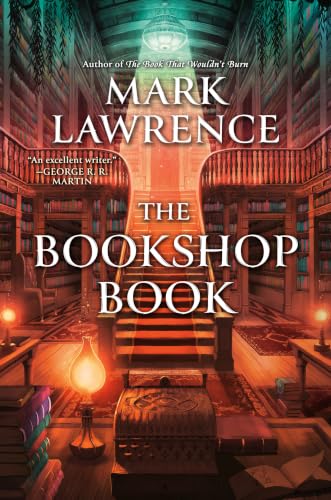
A fantasy adventure through cozy, cluttered bookshops and into the pages of classic literature itself, set in the world of international bestselling author Mark Lawrence’s groundbreaking The Library Trilogy.
Bookshops have always been places where worlds collide. Places where ideas make war, where cultures meet and mingle. For Frederick “Red” Archer, a young man hanging on at the edge of society, a bookshop he wanders into will be the place that changes his life.
Rose Penrose is watching the world from the other side of the page, transported by an act of awful violence into a book her mother wrote. When a terrifying pursuer has Rose cornered, she is somehow able to leap from the book she inhabits into another—one that happens to be in the very bookshop where Red is standing.
This chance encounter entwines their lives together. Now they must journey through beloved fictional words, a great evil following their every step, until they can find the only story that matters—their own.
As a child I read Jane’s Adventures in and Out of the Book by Jonathan Gathorne-Hardy and that tale captured the fascination of interacting or inhabiting the story one is reading. The blurring of boundaries between literature and reality was also explored in the film Inkheart (2009) where characters could both emerge from the pages of a book into our world and also be banished between the covers.

Lawrence had already built that concept of inhabiting a text into his Library Trilogy, where the vaulted reading rooms of the great infinite library contained ‘mechanisms’ – a kind of Virtual Reality room where one could be transported into the reality of any book one carried in there. For Evar and his brothers (Like Jane in her eponymous adventures) the mechanism offered a literal escape into a book.
In The Bookshop Book Lawrence again gives us a pair of protagonists seeking their own escape, but in this case the pursuer can follow them into the book and through various covers into several other books. There is the first person narration by fourteen year old Red, currently living with his older sister in foster care, who opens the story with the telling line
Everyone thinks they’re special as a kid. At least I hope they do, or I’ve just revealed myself as a narcissist. Also, it’s sad to think of children not believing themselves special, at least for a little while.
And there is Rose who lives entirely as a character within a book (or several books), which makes it feel appropriate for her sections of the story to be told in third person.
That dichotomy drives two different kinds of worldbuilding, from Red’s perspective there is the real and recognisable world into which uncanny elements creep and crawl creating a kind of magical realism. Rose’s tale is one of more Dali-esque surrealism – an Alice in Wonderland type experience, where everything is fantastic with occasional protrusions of normality and extrusions into normality.
A key setting is the ramshackle backstreet bookstore named Books (for various reasons I felt there could have been a legitimate apostrophe in the shop name) which evoked for me one of my favourite places, Baggins Bookstore on Rochester High Street in Kent (with a tripadvisor review here, from which the images below are taken).


The proprietor of Books seems as indifferent to his customers as Dylan Moran’s Bernard Black in Black Books, allowing Red to wonder into deep corridors of irregularly stacked ancient books and in that liminal place between fact and fiction, between reality and imagination, the boundary between Red and Rose’s lives can wear thin enough for the two to touch. Throughout, the book and its characters wrestle with that distinction between life and a story, with the one repeatedly nested inside the other like a Russian Doll.
Rose is a character written into a single copy of a book, the last vestige of a lost child, preserved, living and yet still in danger between the pages of (several) books. Her predicament provokes echoes of the kind of virtual-reality-made-real life forms that haunt the pages of Tchaikovsky’s Children of Memory and notions of dead relatives preserved in AI recreations through the wonder of grief-tech, or even players injected into games like the seminal film Tron (1982). But Rose lives in paper and ink, not microchip and hardrive, and she is pursued from book to book – sometimes different iterations of the same book – winning the support of some famous literary characters, but only so long as that book stays free of the corruption that is chasing her. It already feels very Alice in Wonderland even before she arrives in Alice in Wonderland!
This is a book of The Library and there are a number of story elements and setting that will be familiar to readers of that trilogy, but these aspects are sufficiently explained (without recourse in info-dumping) that the The Bookshop Book can be comfortably read as a stand-alone. But Red and Rose’s tale is one small battle in the war that convulses the library, a different front to be opened up at whatever cost to the couple caught in the middle of it.
The Library’s ongoing crisis is over information and how far it can be used or abused. Should the library be destroyed to keep dangerous knowledge from foolish or corrupt hands? Or should it in someway be regulated or decentralised, or simply allowed to incontinently distribute knowledge to whoever asks whether they understand the answers or not? As I think of those questions that I appreciate still more The Library standing as an allegory for the internet and the naivite of its early creators who – too scared to introduce guard rails and too mistrusting to expect governments to do it – left regulation to ‘the market’ (I ranted about this a bit in this post on Jaron Lanier’s book about social media).
As the ‘big bad’ haunting Rose and Red’s steps (in and out of books) explains when railing against the ‘uselessness’ of fiction in the Library’s ‘exchange’
“That’s a trap and you know it. You seek to mire me in lesser knowledge. You dilute secrets with lies, drown truths in useless fiction! Stories- I’ve no need of stories.”
“A story can be more powerful than a fact. There are truths-“
“The Library itself. That is the book I wish to open.”
As with all his books, Lawrence’s prose is a great strength with wry lines, sharp observations and evocative descriptions.
I crossed her palm with nickel-plated steel to hear my fortune and go the full skinny on a future so bright I was definitely going to need shades.
I’ve always been a reader. I’m not one of those people who make out that everyone who doesn’t read is somehow stumbling through life blind to wonders they don’t even know they’re missing. I meant they are, but we all are. Every book read is a series of brisk walks in the countryside missed, just as every nature hike is a missed video game or soap opera or coffee with a friend. There’s too much world to inhale in a single breath of a life, and so we make our choices. Books are mine.
Alders, oaks, and ash marched right to the water’s edge, bringing with them tangled bramble, old nettles, and stands of hog-weed. Within this gloom, shielded from the breeze, gnats hung in their own clouds, mosquitoes whined, and a lone dragonfly skimmed the water, its iridescence flashing when it intersected the occasional finger of sunlight.
The gallop through the greats of literature gives Lawrence the opportunity to explore some well-loved texts – and gives the reader many chances to go “I get that reference”

The fictive characters are mostly drawn from classical fiction (conveniently for any copyright issues, the covers of books of still-living authors resist any effort by Rose to dive into them). That still leaves a welter of familiar faces taking a diversion or interlude from the tales that had been written for them in order to support or protect Rose. Of the non-fiction characters, I particularly enjoyed the appearance of one J. Campbell waxing lyrical about hearing the call to action, and refusing the call as he attempts to advise/instruct our heroine on the stages in her journey.
Throughout the tumbling adventures with lots of falling in, out and within different books, Rose and Red make engaging adolescent protagonists with distinctive voices as Lawrence expertly blends the surrealist and the realist in another compelling tale.

Leave a Reply